
A smart factory is a plant in which machines, equipment, products and IT systems are connected end to end, and production data is used continuously for control, planning and improvement. The term is part of the Industrie 4.0 concept. A smart factory is rarely built on a greenfield site. It usually develops step by step in existing plants: first the equipment is connected, then its data is linked with orders, quality and planning. The recommendations for implementing the strategic initiative Industrie 4.0 describe the smart factory as a core element of Industrie 4.0. Its production resources connect independently, and products know their history and their current state. The recommendations were published by the Forschungsunion Wirtschaft-Wissenschaft and acatech; the final report appeared on 8 April 2013. The term Industrie 4.0 was presented publicly on 3 April 2011 at the opening of the Hannover Messe by Wolfgang Wahlster, founding director of the German Research Center for Artificial Intelligence (DFKI). As early as 2005, the Technologie-Initiative SmartFactory KL was founded in Kaiserslautern as a vendor-independent demonstration and research platform. The practical reason for connecting a plant is usually simple: losses in production are hard to see without data. A common measure is overall equipment effectiveness (OEE), the product of availability, performance and quality. A machine with 90 % availability, 95 % performance and 98 % quality reaches 0.90 · 0.95 · 0.98 ≈ 84 %. Three good individual values add up to a noticeably lower total. The example is purely arithmetical. It shows why losses can only be tackled in a targeted way with continuously recorded machine data. A smart factory builds on concepts that are described in standards and specifications. Four mechanisms carry the concept. The sequence is similar in most plants. Which equipment delivers which data today, through which controllers and protocols, and where do losses occur? The most important machines are connected to a shared data layer without interfering with their control logic. A clearly bounded goal, such as downtime at a bottleneck machine, is tackled with data and measured. Further equipment, lines and sites follow by value. The data flows into MES, ERP and planning. Four distinctions prevent false expectations. These points slow down smart factory projects most often. A smart factory is not a state that is reached at some point. Every connected machine has to be operated, secured and maintained. For a plant with few, stable machines, it can make more sense to address individual bottlenecks than to plan comprehensive connectivity. pronubes addresses the foundation of every smart factory: the connection between equipment and business systems. The product components have different tasks. Industrie 4.0 is the overarching concept for the digital networking of production and value creation. The smart factory is a core element of it and describes the connected plant itself. Usually not. Many existing machines can be connected through their controllers or through retrofitted sensors. What matters is a connection that does not interfere with the control logic. They remain central systems for order control and planning. In a smart factory, they receive continuous data from production instead of delayed manual feedback. That depends on the equipment, the goals and the starting point. First results can be achieved with a clearly bounded use case. Connecting an entire plant is a project spanning several expansion stages. Every connection widens the attack surface. That is why a clear separation of network zones, controlled connections and monitoring of data flows belong in the plan from the start. pronubes connects machines, controllers and business applications and makes production data usable where your processes need it.What is a smart factory and how is it built?
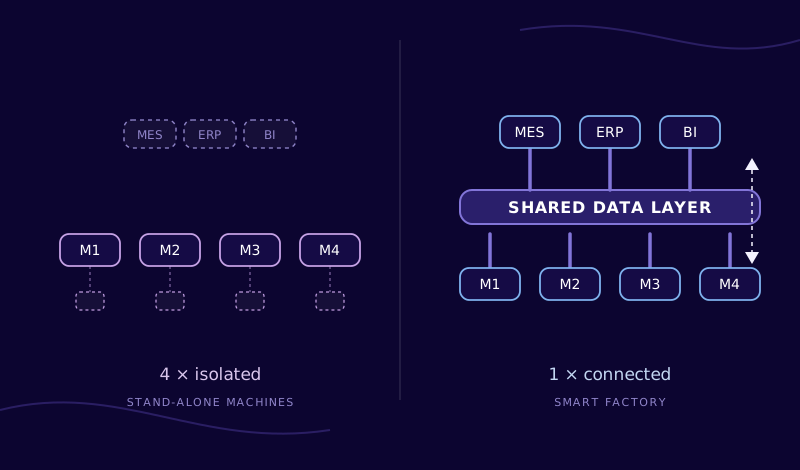
Definition: smart factory
Characteristic
Conventionally automated plant
Smart factory
Connectivity
Equipment works largely on its own, data stays in the controller
Equipment, products and IT systems exchange data continuously
Planning
Fixed plans, deviations are updated manually
Plans adapt to the actual state of production
Transparency
Figures at the end of the shift or in the monthly report
Status of equipment and orders visible at any time
Changes
Rebuilding and reprogramming per machine
Configuration through shared data and interfaces
Improvement
Experience of individual people
Analysis of production data, complemented by experience
Why plants are being connected
The building blocks of a smart factory
Building block
Task
Origin
Vertical integration
Connects sensors, control, MES and ERP within one plant
Recommendations for Industrie 4.0, 2013
Horizontal integration
Connects process steps, sites and partners along the value chain
Recommendations for Industrie 4.0, 2013
Level model
Orders functions from the equipment up to enterprise planning
ANSI/ISA-95 (2000), IEC 62264-1 (2003)
Reference architecture
Describes Industrie 4.0 components across hierarchy levels, life cycle and layers
RAMI 4.0, DIN SPEC 91345, April 2016
Asset Administration Shell
Digital representation of an asset with a standardised data structure
Industrial Digital Twin Association, founded in 2020 by VDMA, ZVEI, Bitkom and 20 companies
How a smart factory works technically
Four steps to a smart factory
Assess the starting point
Connect the equipment
Start with one use case
Expand step by step
What a smart factory is not
Typical hurdles in practice
How pronubes supports
Frequently asked questions
What is the difference between a smart factory and Industrie 4.0?
Do you need new machines for a smart factory?
What role do MES and ERP play in a smart factory?
How long does the journey to a smart factory take?
Is a smart factory a security risk?
The smart factory starts with the first connected machine.
pronubes is a product of inray Industriesoftware GmbH. Over 30 years of industrial software from Germany. Innovative and reliable for manufacturing companies.