
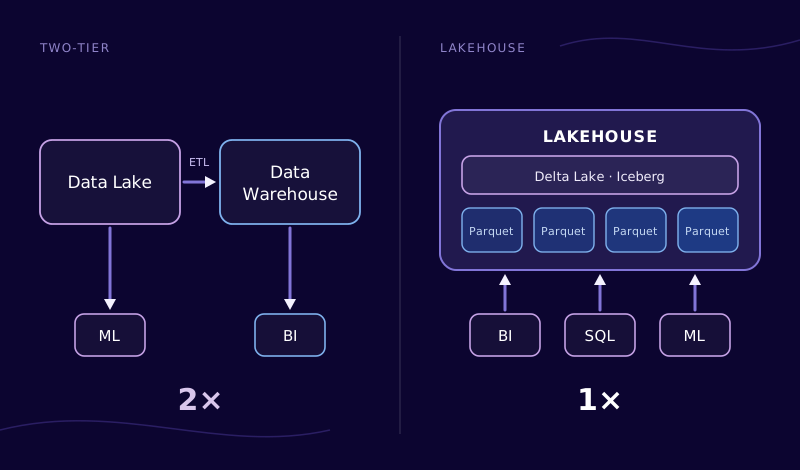
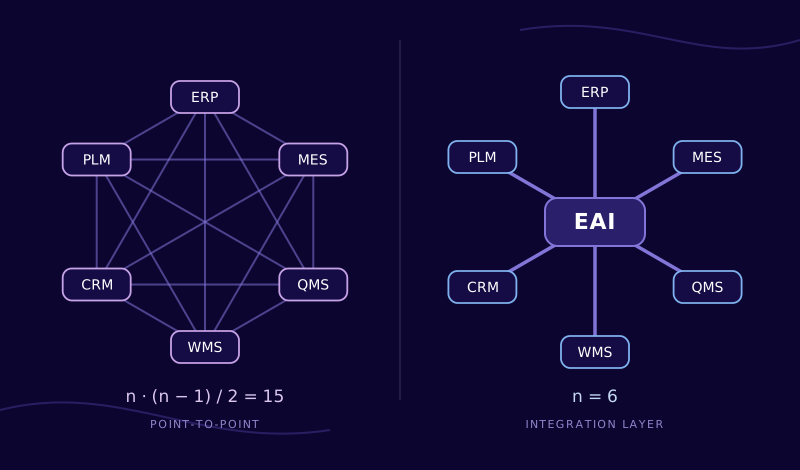
A data fabric is an architectural concept that makes distributed data sources usable through a shared layer of metadata, integration and access rules, without copying all data to one place. The data stays in ERP, MES, historians or cloud storage. The fabric knows where which data is, what it means and who may use it. In industry, its value depends on whether production data arrives with context such as asset, line and order. Gartner describes the data fabric as a design concept that serves as an integrated layer of data and connecting processes, based on continuous analytics over existing and inferred metadata. Gartner analyst Mark Beyer put it this way in an article published on 25 August 2021. It is not a single product but an architecture: systems stay as they are, and a layer above them handles discovery, access and delivery. Production data is used by more and more functions: controlling, quality, maintenance, energy management and, increasingly, analytics and AI applications. Often every new question gets its own connection or its own copy of the data. A simple calculation shows how fast this grows. If each of n consumers pulls its own data from each of m sources, up to m · n connections emerge. With 8 sources and 6 consumers, that is 48. With a shared layer, each source and each consumer needs only one connection, m + n in total, so 14 here. The calculation illustrates the principle. In practice not every consumer needs every source, but the pattern of many copies with different states remains the actual problem. The term itself predates the current trend. Forrester published a market evaluation of the “big data fabric” in the fourth quarter of 2016 (analyst Noel Yuhanna). Gartner listed the data fabric among its “Top Strategic Technology Trends for 2022”. A data fabric consists of a small number of building blocks. They do not have to come from one vendor. Four mechanisms carry the architecture. The sequence is similar in most projects. Which systems deliver which data to whom today, through which path and how up to date? Asset, line, order and material are named consistently so that metadata matches across system boundaries. A clearly bounded need, such as energy figures per asset, is the first to run through the fabric and is measured. Further sources and consumers follow by value. Duplicate copies and individual connections are replaced deliberately. Four distinctions prevent false expectations. These points slow down data fabric projects most often. A data fabric shifts work, it does not remove it. Instead of many load processes, metadata, terms and access rules have to be maintained permanently. With few sources and fixed reporting, a well-run data warehouse is often the simpler solution. pronubes starts at the beginning of the chain: where production data is created and gets its context. The product components have different tasks. The data fabric is an architectural pattern that makes distributed data accessible through metadata and a shared integration layer. The data mesh is primarily an organisational model in which business domains own their data as products. Many companies use elements of both. No. A data warehouse or a lakehouse can be part of the fabric. The fabric governs how data from these and other sources is found, described and delivered. No, that is precisely not the approach. The data largely stays in the source systems. It is copied only where performance, availability or analysis require it. It is among the most valuable and most difficult sources. Machine data is created at high frequency and without business context. To be usable in the fabric, it has to be connected in the plant, structured and assigned unambiguously. With an inventory of sources and consumers, consistent terms for central objects and a clearly bounded use case. The choice of tools follows from that, not the other way round. pronubes connects machines and systems in the plant and delivers production data with context to your data platform.What is a data fabric and what does it mean for industry?
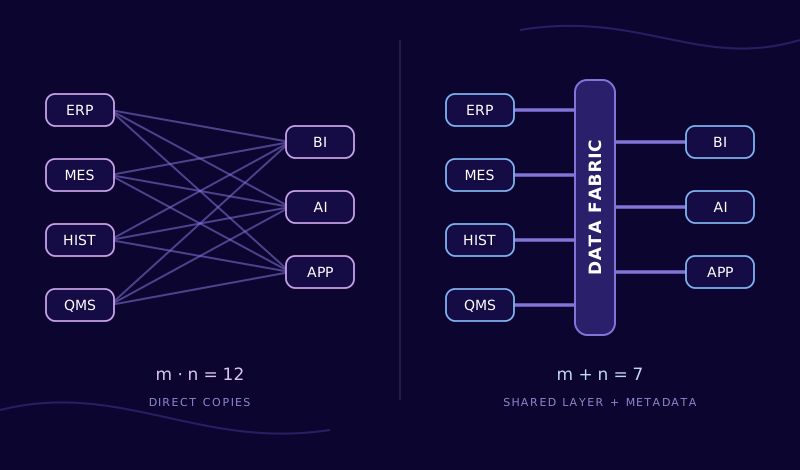
Definition: data fabric
Characteristic
Central data copy
Data fabric
Storage location
All data is copied into one central store
Data stays in the source systems and is copied only when needed
Meaning of the data
Hidden in load processes and table structures
Recorded in metadata and relationships visible to all users
Access rules
Defined again for each store
Defined once and applied to every access path
New source
New load process into the central store
Connection to the fabric and description in the metadata
Typical use
Few sources, fixed reporting
Many sources across several sites, changing questions
Why the topic matters
The building blocks of a data fabric
Building block
Task
Origin
Metadata catalogue
Records which data exists, where it is and who owns it
Core of the data fabric according to Gartner, 2021
Active metadata
Continuously analyses how data is used and steers delivery and quality accordingly
Gartner, Mark Beyer, 25 August 2021
Knowledge graph
Represents relationships between data objects, for example asset, order and material
Named by Gartner as a building block, 2021
Integration services
Deliver data by copy, data stream or virtual access
Integration styles according to Hohpe and Woolf, Enterprise Integration Patterns, 2003
Governance and access
Define who may see which data in which form
Part of every data fabric architecture
How a data fabric works technically
Four steps to a data fabric
Map sources and consumers
Agree on shared terms
Start with one use case
Extend step by step
What a data fabric is not
Typical hurdles in practice
How pronubes supports
Frequently asked questions
What is the difference between a data fabric and a data mesh?
Does a data fabric replace the data warehouse?
Do you have to store all data centrally for a data fabric?
What role does production data play in a data fabric?
How do you start with a data fabric?
A data fabric starts in production.
pronubes is a product of inray Industriesoftware GmbH. Over 30 years of industrial software from Germany. Innovative and reliable for manufacturing companies.