
data-driven production — Turning production data into decisions
Making data usable where it’s needed
In many companies, production, machine, and enterprise data exist but often remain siloed in separate systems. data-driven production connects this information and makes it available where decisions are made and processes are controlled.
pronubes provides the technical foundation for this: the platform connects IT and OT, makes data flows traceable, and brings relevant information all the way into production.
- data-driven production
- Corporate Data
What is data-driven production?
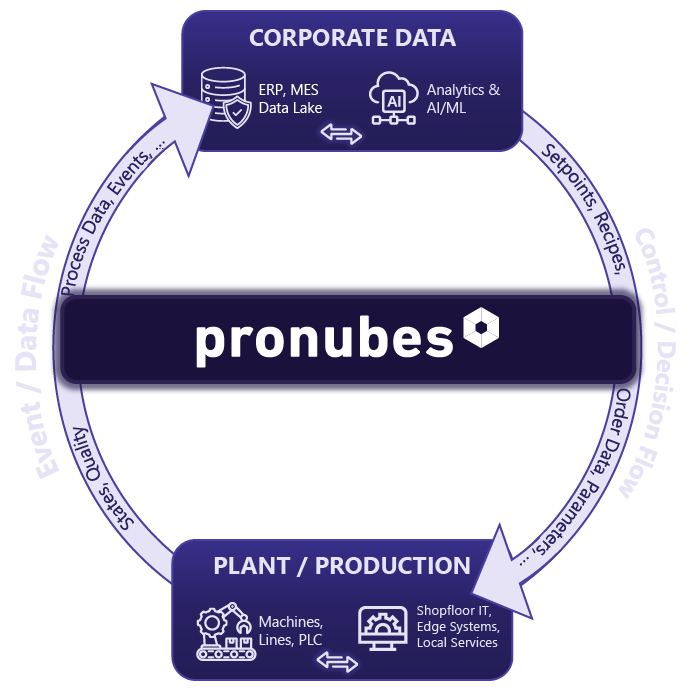
data-driven production refers to a production approach where decisions are based not on experience or gut feeling, but on real-time data from machines, equipment, and enterprise systems. Production data is not only collected but actively fed back into processes through an end-to-end data infrastructure.
data-driven production typically comprises three steps:
- Collect: Bring together machine, process, and enterprise data
- Analyze: Translate data into actionable insights and decisions
- Feed back: Feed decisions back into production in an automated or controlled way (closed loop)
Data silos are costing real competitiveness today
In most manufacturing companies, the data already exists, it’s just not where it’s needed. Machine data sits in one system, quality data in another, order data in a third. Each system works perfectly fine on its own. What’s missing is the flow of data between them.
An everyday example: a shift supervisor notices a quality deviation but can’t immediately cross-check it against the machine parameters from the last hour, because both data sources are separate. Reconstructing the cause and the connection manually takes hours, sometimes days. The decision comes too late, or not in time at all.
This is exactly where data-driven production comes in: not as another tool alongside the existing systems, but as a connecting data infrastructure that brings more flexibility to existing workflows.
From data signal to effective decision
Data only creates impact once signals become decisions and those decisions flow back into the processes in a controlled way. This closed loop is the core of data-driven production: an end-to-end data flow that doesn’t just run in one direction, but feeds directly back into the shopfloor, with the goal of greater automation of manual workflows.
For this to work reliably, six fundamental capabilities need to work together:
How data-driven production works in practice
The six core capabilities aren’t an end in themselves, they translate into concrete, everyday situations in production, partly supported by AI-assisted analysis. Four examples of how data turns into tangible improvements:
pronubes — The building block behind data-driven production
pronubes is inray’s platform for data-driven production: a shared foundation that connects and makes usable production data from machines, equipment, and enterprise systems. Instead of isolated point solutions, pronubes brings together connectivity, processing, and security in one end-to-end system, from the edge to the cloud and back to the shopfloor. Four building blocks form the foundation: