
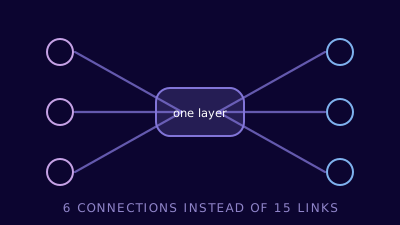
Enterprise Application Integration (EAI) refers to methods and software that let a company’s applications exchange data and processes without every application needing its own interface to every other one. Instead of many point-to-point connections, an integration layer translates, routes and monitors messages. In industry, EAI typically connects ERP, MES, quality and warehouse systems. Connecting the machine level is a separate task. David S. Linthicum described EAI in November 1999 in his book “Enterprise Application Integration” (Addison-Wesley) as technologies that let business processes and data speak to one another across applications. It does not refer to a specific product but to an architectural approach: applications stay independent, and an integration layer controls which data goes where, when and in which form. Companies usually introduce applications one after another: first an ERP, then an MES, later quality, warehouse and maintenance systems. Every introduction brings new interfaces. As long as there are only a few applications, direct connections are enough. A simple calculation shows how quickly this tips over. If n applications are each to be connected directly, n · (n − 1) / 2 interfaces are needed. With 5 applications that is 10, with 10 applications 45 and with 20 applications 190. With an integration layer, each application needs only one connection, so 5, 10 or 20. The calculation illustrates the principle. In practice not every application is connected to every other one, but the disproportionate growth in interfaces remains the core of the problem. In 2003, Gregor Hohpe and Bobby Woolf collected 65 patterns for message-based integration in “Enterprise Integration Patterns” (Addison-Wesley). Many integration tools still refer to these patterns today. EAI is made up of a few well-described building blocks. Four mechanisms carry the architecture. The order is similar in most projects. Which applications exchange which data today, through which interfaces, and who is responsible for them? Terms such as order, material or asset are defined consistently so that each translation is built only once. A clearly bounded process, such as confirming production orders, is the first to run through the integration layer and is measured. Further interfaces follow according to benefit and risk. Old point-to-point connections are switched off deliberately. Four boundaries prevent false expectations. These points slow down integration projects most often. EAI reduces the number of interfaces, not the work of understanding the data. The integration layer is itself a system that has to be operated, monitored and maintained. With three applications and stable processes, a well-documented direct interface can be the simpler solution. pronubes starts where classic EAI often stops: at the connection between production and business applications. The product components have different tasks. EAI is the overall approach of connecting applications through an integration layer. An ESB is a specific form of that layer: integration services for routing, transformation and protocol conversion instead of a single central broker. The term is older, the task is not. Today application integration is often implemented with cloud integration platforms (iPaaS), APIs and event-based messaging. The basic patterns of channels, routing and transformation are the same. APIs define how a single application is addressed. EAI governs how data flows between many applications and how it is translated and monitored. In practice the two complement each other. For the machine level, usually yes. Controllers speak different protocols from business applications and need a connection close to the equipment. The results can then flow into the existing EAI landscape. With an inventory of the existing interfaces and one clearly bounded process that is the first to run through the integration layer. Only then is it worth migrating further interfaces. pronubes connects machines, controllers and business applications and makes production data usable where your processes need it.What is Enterprise Application Integration (EAI) and what does it offer industry?
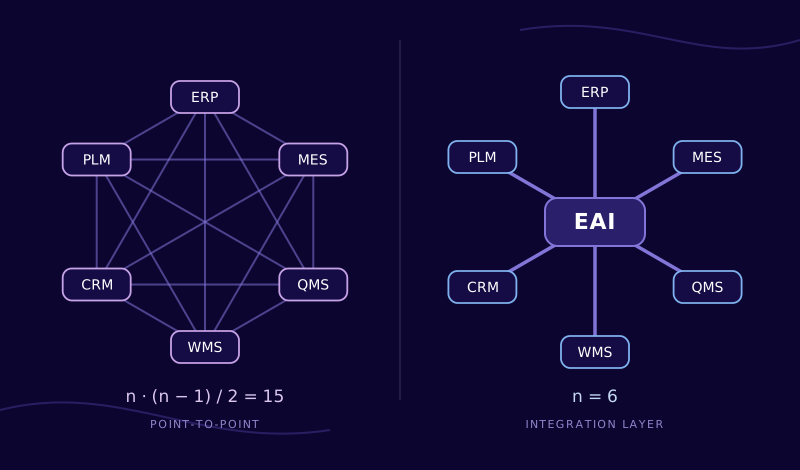
Definition: Enterprise Application Integration
Characteristic
Point-to-point
EAI with an integration layer
Connections
Every application directly with every other one
Every application once with the integration layer
Data formats
Translation in every single interface
Translation in one place, based on a shared data model
Changes
Affect every interface involved
Usually affect only one adapter
Monitoring
Spread across many places
Visible in one place
Typical use
Few applications, stable processes
Many applications, frequent changes
Why application integration becomes necessary
The building blocks of EAI
Building block
Purpose
Origin
Integration styles
Four basic forms of exchange: file transfer, shared database, remote procedure invocation and messaging
Hohpe and Woolf, Enterprise Integration Patterns, 2003
Message broker
Central instance that receives, translates and distributes messages (hub and spoke)
Classic form of EAI
Enterprise service bus (ESB)
Integration layer made of services for routing, transformation and protocol conversion
Term popularised from 2002 by Roy W. Schulte (Gartner), book by David Chappell, O’Reilly, 2004
Messaging protocols
Standardised message exchange between applications and devices
AMQP 1.0 OASIS Standard since 29 October 2012, MQTT OASIS Standard since 29 October 2014
Adapters
Connect the integration layer to a specific application and its interface
Part of every EAI solution
How EAI works technically
Application integration in four steps
Map the landscape
Agree on a shared data model
Start with one process
Migrate step by step
What EAI is not
Typical hurdles in practice
How pronubes supports you
Frequently asked questions
What is the difference between EAI and an ESB?
Is EAI still relevant?
How does EAI differ from an API strategy?
Does production need its own integration solution?
How do you get started with EAI?
Integration does not end at the ERP.
pronubes is a product of inray Industriesoftware GmbH. Over 30 years of industrial software from Germany. Innovative and reliable for manufacturing companies.