
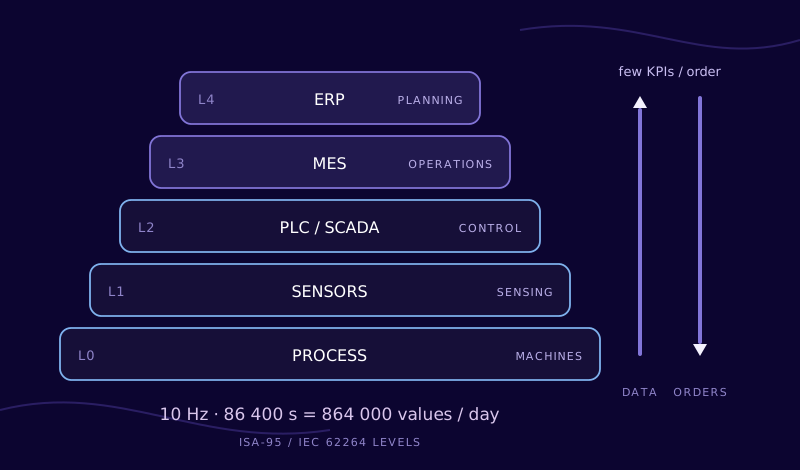
In manufacturing, vertical integration means the end-to-end connection of all levels of a plant: from sensors and controllers through supervisory systems and MES to the ERP. Data from the equipment reaches planning and order management without manual steps, and orders and specifications travel back to the equipment. It is one of the three characteristics of Industrie 4.0. It does not refer to the business strategy of the same name, in which a company takes over upstream or downstream stages of its supply chain. The recommendations for implementing the strategic initiative Industrie 4.0 (Forschungsunion and acatech, final report of 8 April 2013) name three characteristics of Industrie 4.0. One of them is vertical integration and networked manufacturing systems: the plant connects its levels end to end, from sensors to enterprise management, and thereby becomes flexible and reconfigurable. The other two characteristics are horizontal integration through value networks and end-to-end digital engineering. The level model itself is older than Industrie 4.0. The Purdue reference model for computer-integrated manufacturing (CIM) was published by the Instrument Society of America in October 1989. The ANSI/ISA-95 standard builds on it; its first part appeared in 2000 and was adopted internationally as IEC 62264-1 in 2003. The levels differ above all in cycle time and data volume. A single signal recorded ten times per second produces 10 · 86,400 = 864,000 values per day. With 500 signals in a plant, that is 432 million values daily. The ERP needs only a few aggregated figures per order, such as quantity, scrap and duration. The calculation is an example. It shows why vertical integration does not mean sending all data upwards, but aggregating it and adding context along the way. ISA-95 describes five levels. The standard deals mainly with the interface between level 3 and level 4. The Reference Architecture Model Industrie 4.0 (RAMI 4.0, DIN SPEC 91345, April 2016) adopts this hierarchy from IEC 62264 and adds the product itself and the connected world outside the plant. Four mechanisms carry the connection between levels. The sequence is similar in most plants. Which information moves between equipment, MES and ERP today, through which path and with what delay? For each transition between two levels, it is decided which data flows, at which level of aggregation and at which rate. A clearly bounded process, such as automatic reporting of quantities to the ERP, is implemented and measured. Further equipment and processes follow. Manual confirmations and individual exports are replaced deliberately. Four distinctions prevent false expectations. These points slow down vertical integration projects most often. Vertical integration makes processes faster and more accurate, but also more dependent on the data connection. If a transition fails, confirmations are missing in planning and accounting. Buffering, monitoring and a fallback with manual confirmation are therefore part of the implementation. pronubes addresses the transitions between equipment, MES and ERP. The product components have different tasks. Vertical integration connects the levels within a plant, from the equipment to the ERP. Horizontal integration connects process steps, sites and partners along the value chain. Both are characteristics of Industrie 4.0 and complement each other. The automation pyramid shows the levels of a plant, and vertical integration connects them. Modern architectures partly dissolve the rigid pyramid, but the functional levels remain. Not necessarily, but often. The MES takes on many tasks between equipment and ERP, such as order management and confirmation. Without an MES, these tasks have to be handled elsewhere. OPC UA is a widely used open standard for providing data from controllers in a structured way. It simplifies the lowest connection in vertical integration, but it does not replace the data model of the upper levels. With an inventory of today’s data flows between equipment, MES and ERP and a clearly bounded process such as automatic quantity reporting. Further equipment and processes follow. pronubes connects machines, controllers and business applications and brings production data with context to where it is needed.What is vertical integration in manufacturing?
Definition: vertical integration
Characteristic
Separate levels
Vertically integrated
Order confirmation
Manual or by export at the end of the shift
Automatically from the equipment, linked to the order
Specifications for the equipment
Printed, retyped or maintained locally
Passed directly from MES or ERP to the line
Key figures
Delayed and often calculated differently per department
From the same data for all levels
Changes
Affect many individual interfaces
Through defined transitions between levels
Troubleshooting
Comparing lists from several systems
Data flow traceable from the equipment to the ERP
Why the levels are being connected
The levels of vertical integration
Level
Content
Typical systems
Level 0
Physical production process
Machines, equipment, workpieces
Level 1
Sensing and manipulating the process
Sensors, actuators, valves
Level 2
Monitoring and control
PLC, distributed control systems, SCADA
Level 3
Manufacturing operations management
MES, quality and maintenance systems
Level 4
Business planning and logistics
ERP
How vertical integration works technically
Four steps to vertical integration
Map the data flows
Define the transitions
Start with one process
Extend step by step
What vertical integration is not
Typical hurdles in practice
How pronubes supports
Frequently asked questions
What is the difference between vertical and horizontal integration?
What does the automation pyramid have to do with vertical integration?
Does vertical integration require an MES?
What role does OPC UA play?
How do you start with vertical integration?
From the machine to the ERP, without media breaks.
pronubes is a product of inray Industriesoftware GmbH. Over 30 years of industrial software from Germany. Innovative and reliable for manufacturing companies.