
In industry, horizontal integration means connecting process steps, sites and companies along the value chain, from the supplier through your own production to the customer. Information on demand, quantities, dates and quality flows from one stage to the next without manual steps. It is one of the three characteristics of Industrie 4.0. It does not refer to the economic term of the same name, which describes the merger of companies at the same stage. The recommendations for implementing the strategic initiative Industrie 4.0 (Forschungsunion and acatech, final report of 8 April 2013) describe horizontal integration through value networks as building value chains across company boundaries. The goal is coordinated collaboration from order to delivery. In practice, the term is also used within a single company, for example for connecting consecutive production steps or several plants. Electronic exchange between companies is not a new idea. The international standard ISO 9735 for EDIFACT, data interchange for administration, commerce and transport, was published in 1988. What is new is the breadth: today, production, quality and product data should flow between stages alongside orders and delivery notes. A simple example shows how delays add up. If each of four stages in a chain passes on a change in demand only with the next daily reconciliation, it can take up to four days for the change to reach the first-tier supplier. If changes are passed on as events, the information arrives within minutes. The figures are an arithmetical example. They show why the type of connection matters more than the amount of data exchanged. Horizontal integration relies on standards and initiatives for exchange between stages and partners. Four mechanisms carry the exchange between stages. The sequence is similar in most projects. Which stages, sites and partners exchange which information today, through which path and with what delay? For each transition, it is decided which data flows in which format, at which rate and under which rules. A clearly bounded exchange, such as confirmations between two plants, is implemented and measured. Further stages and partners follow. Manual coordination is replaced deliberately by defined interfaces. Four distinctions prevent false expectations. These points slow down horizontal integration projects most often. Horizontal integration across company boundaries depends on both sides taking part. A single company can prepare the exchange, but it cannot force it. It is therefore usually worth connecting the transitions within your own company first, between production steps and sites. pronubes creates the foundation that horizontal integration builds on: structured production data at every site. The product components have different tasks. Horizontal integration connects process steps, sites and partners along the value chain. Vertical integration connects the levels within a plant, from the equipment to the ERP. Both are characteristics of Industrie 4.0 and complement each other. No. The recommendations for Industrie 4.0 emphasise value creation across companies. In practice, the term is also used for connecting production steps and plants within one company. EDI is widely used for orders, delivery notes and invoices. For production and quality data it is often not sufficient, which is why further formats and approaches such as the Asset Administration Shell and data spaces are added. Data spaces create shared rules, formats and trust mechanisms for exchange between many companies in an industry. They are one way of implementing horizontal integration across company boundaries. With an inventory of today’s handovers between stages and sites and a clearly bounded transition within your own company. Only then is it worth extending to external partners. pronubes connects machines, controllers and systems at every site and creates the data foundation for exchange along the chain.What is horizontal integration in industry?
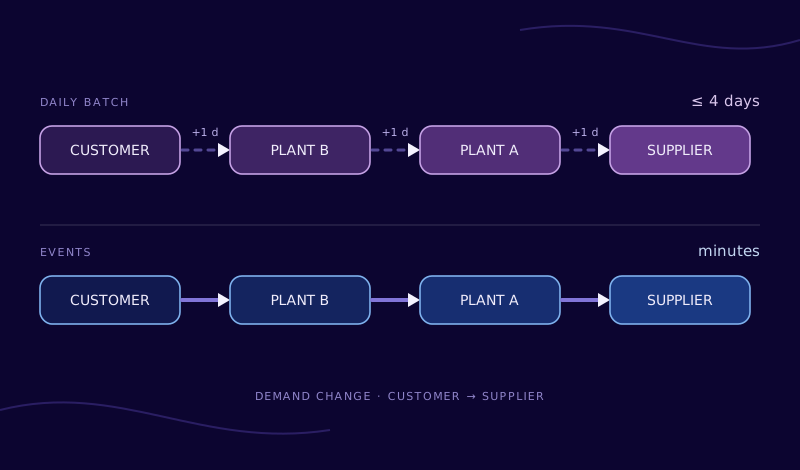
Definition: horizontal integration
Characteristic
Separate stages
Horizontally integrated
Passing on information
By e-mail, spreadsheet or phone
Through defined, machine-readable interfaces
Changes in demand
Reach the next stage with a delay
Are passed on to all affected stages
Inventory
Buffers against uncertainty at every stage
Aligned with known demand
Quality data
Stays with each manufacturer
Is passed on with the product
Traceability
Comparing documents from several places
Traceable across the chain
Why value chain stages are being connected
The building blocks of horizontal integration
Building block
Task
Origin
Electronic data interchange (EDI)
Standardised business messages such as order, delivery note and invoice
EDIFACT, ISO 9735, 1988
Asset Administration Shell
Standardised digital representation of an asset that can be read across company boundaries
Industrial Digital Twin Association, founded in 2020 by VDMA, ZVEI, Bitkom and 20 companies
Data spaces
Shared rules for controlled data exchange between companies in an industry
Catena-X Automotive Network e.V., founded in 2021 by 17 companies and research institutions
Reference architecture
Describes Industrie 4.0 components up to the connected world outside the plant
RAMI 4.0, DIN SPEC 91345, April 2016
Integration within the company
Connects systems of consecutive process steps and sites
Integration patterns according to Hohpe and Woolf, Enterprise Integration Patterns, 2003
How horizontal integration works technically
Four steps to horizontal integration
Map the chain
Define the exchange
Start with one transition
Extend step by step
What horizontal integration is not
Typical hurdles in practice
How pronubes supports
Frequently asked questions
What is the difference between horizontal and vertical integration?
Does horizontal integration only apply between companies?
What role does EDI still play today?
What do data spaces such as Catena-X have to do with horizontal integration?
How do you start with horizontal integration?
Value creation does not end at the factory gate.
pronubes is a product of inray Industriesoftware GmbH. Over 30 years of industrial software from Germany. Innovative and reliable for manufacturing companies.