
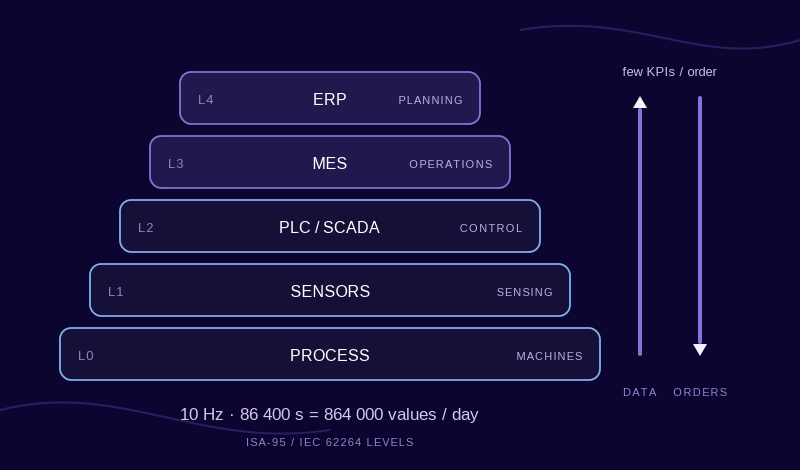
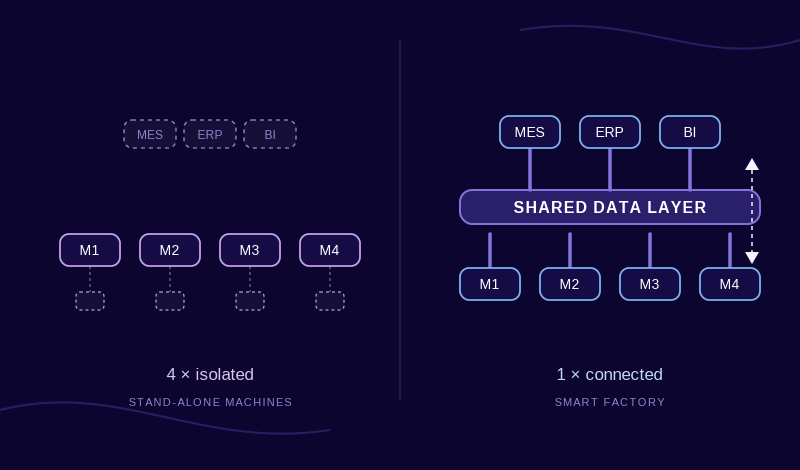
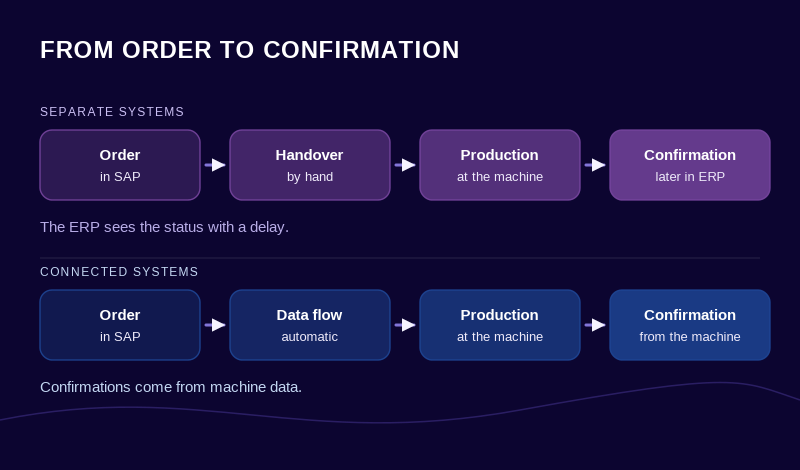
An MES (manufacturing execution system) controls and documents ongoing production between business planning and the equipment. It takes orders from the ERP, schedules them in detail across machines and shifts, passes specifications to the line and reports quantities, times, scrap and quality data back. In the level model of the ISA-95 standard series, the MES sits at level 3. How well an MES performs depends heavily on how reliably it is connected to the equipment and the ERP. The German guideline VDI 5600 Part 1 on manufacturing execution systems, issued in October 2016, describes an MES in terms of its tasks. It is intended as a guide for decision-makers, project participants and vendors. Internationally, the ISA-95 standard series (IEC 62264) assigns the tasks of manufacturing operations management to level 3, between process control and business planning. The role becomes clearest in comparison with the neighbouring systems. In 1997, the industry association MESA International described in its white paper “MES Functionalities and MRP to MES Data Flow Possibilities” which functions an MES takes on and which data flows between planning and production. The ISA-95 standard series followed from 2000 and was adopted internationally as IEC 62264-1 in 2003. Part 3, with the activity models of manufacturing operations management, was published as IEC 62264-3 in June 2007 and as ANSI/ISA-95.00.03 in 2013. The practical reason is usually the gap between plan and reality. A calculation with assumed values: 20 machines, three shifts and eight confirmations per machine and shift add up to 20 · 3 · 8 = 480 postings per day. If each manual posting takes 45 seconds, that is 480 · 45 s = 21,600 seconds, or six hours of data entry every day. On top of that come typing errors and confirmations that only arrive at the end of the shift. An MES with automatic data capture shortens this time and makes the order status visible during the shift. IEC 62264-3 divides manufacturing operations management at level 3 into four areas. The VDI 5600 guideline series covers additional topics such as energy management with MES in further parts. Which areas an MES covers differs by vendor and industry. Many plants start with order confirmation and machine data collection and add quality and maintenance later. An MES depends on its connections downwards and upwards. Four points determine how well this works. The sequence is similar in most plants. Which confirmations, inspections and records exist today, where do waiting times and errors occur, and which key figures should improve? Which machines deliver which data, how good is the master data in the ERP, and which handovers need to be acknowledged? A bounded area is connected, for example automatic quantity and downtime reporting on one line. Results are measured. Further lines and plants follow the same pattern. Quality, maintenance or energy are added as further areas. Four distinctions help with the selection. These points decide success more often than the choice of software. An MES maps processes; it does not improve them on its own. Unclear processes and incomplete master data simply become visible faster with an MES. And an MES is only as current as its connections: if the connection to a line fails, confirmations are missing and order statuses are no longer correct. pronubes is not an MES. pronubes makes sure that an MES reliably receives the data from the equipment and that its specifications arrive safely at the line. The product components have different responsibilities. Not every plant needs a full MES right away. If you first want to create transparency, for example with real-time dashboards, digital shift logs, digital checklists or workflows, inray also offers manubes, a cloud-based platform for industrial production management that runs without your own servers. The ERP plans demand, capacity and cost over weeks and days. The MES controls execution in production over shifts, hours and minutes and reports actual data back to the ERP. ISA-95 assigns the ERP to level 4 and the MES to level 3. Typical tasks are detailed scheduling and order release, confirming quantities and times, capturing machine states and downtime, quality inspections and assigning material and batches. IEC 62264-3 groups these into production, maintenance, quality, and material and inventory. No. An MES pays off above all when many orders, variants or documentation requirements come together. Smaller operations often start with machine data collection and digital confirmation and expand later. ISA-95 provides the level model and shared terms for the exchange between ERP and production. Many MES base their data models and interfaces on it, which makes connecting to different ERP systems easier. Through the controllers of the equipment, mostly with open standards such as OPC UA or MQTT, and for older machines also via dedicated drivers or retrofitted sensors. What matters is that data arrives with reference to order and machine and that controlling specifications are acknowledged. pronubes connects equipment, MES and ERP and moves order and production data reliably in both directions.What is an MES (manufacturing execution system)?
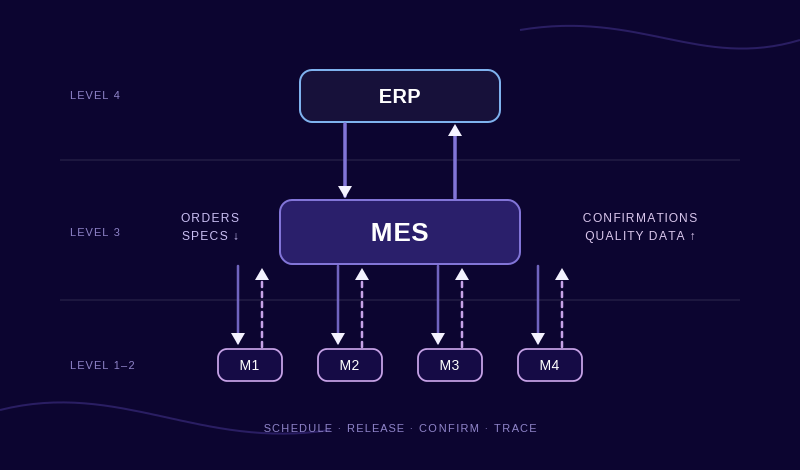
Definition: MES
Characteristic
ERP
MES
Control level
Level according to ISA-95
Level 4
Level 3
Levels 1 and 2
Typical time horizon
Weeks and days
Shifts, hours and minutes
Seconds and below
Subject
Demand, capacity, cost
Order in execution
Machine and process
Typical data
Customer order, bill of materials, due date
Operation, batch, scrap, downtime
Signals, states, measurements
Result
Planning and posting
Control and record of production
Execution in the process
Why plants use an MES
The functional areas of an MES
Area
Typical tasks
Basis
Production
Detailed scheduling, order release, execution, confirmation
IEC 62264-3, production operations management
Maintenance
Maintenance orders, faults, equipment history
IEC 62264-3, maintenance operations management
Quality
Inspections, measurements, releases, deviations
IEC 62264-3, quality operations management
Material and inventory
Staging, batches, stock movements in production
IEC 62264-3, inventory operations management
Energy
Consumption per machine, order or product
VDI 5600 Part 6, energy management with MES
How an MES is connected
Four steps to an MES
Clarify processes and goals
Check data and interfaces
Start with one line
Roll out and extend
What an MES is not
Typical hurdles in practice
How pronubes supports
Frequently asked questions
What is the difference between MES and ERP?
What does an MES actually do?
Does every company need an MES?
What does ISA-95 mean for an MES?
How is an MES connected to machines?
An MES is only as good as its data.
pronubes is a product of inray Industriesoftware GmbH. Over 30 years of industrial software from Germany. Innovative and reliable for manufacturing companies.