
What is IT/OT convergence?
IT/OT convergence describes the merging of information technology (IT) and operational technology (OT) into a shared data landscape. It isn’t about technically connecting a machine to the network — it’s about merging two worlds that have so far spoken different languages, held different security standards and set different priorities — and about how IT methods reach the shop floor without endangering its stability.
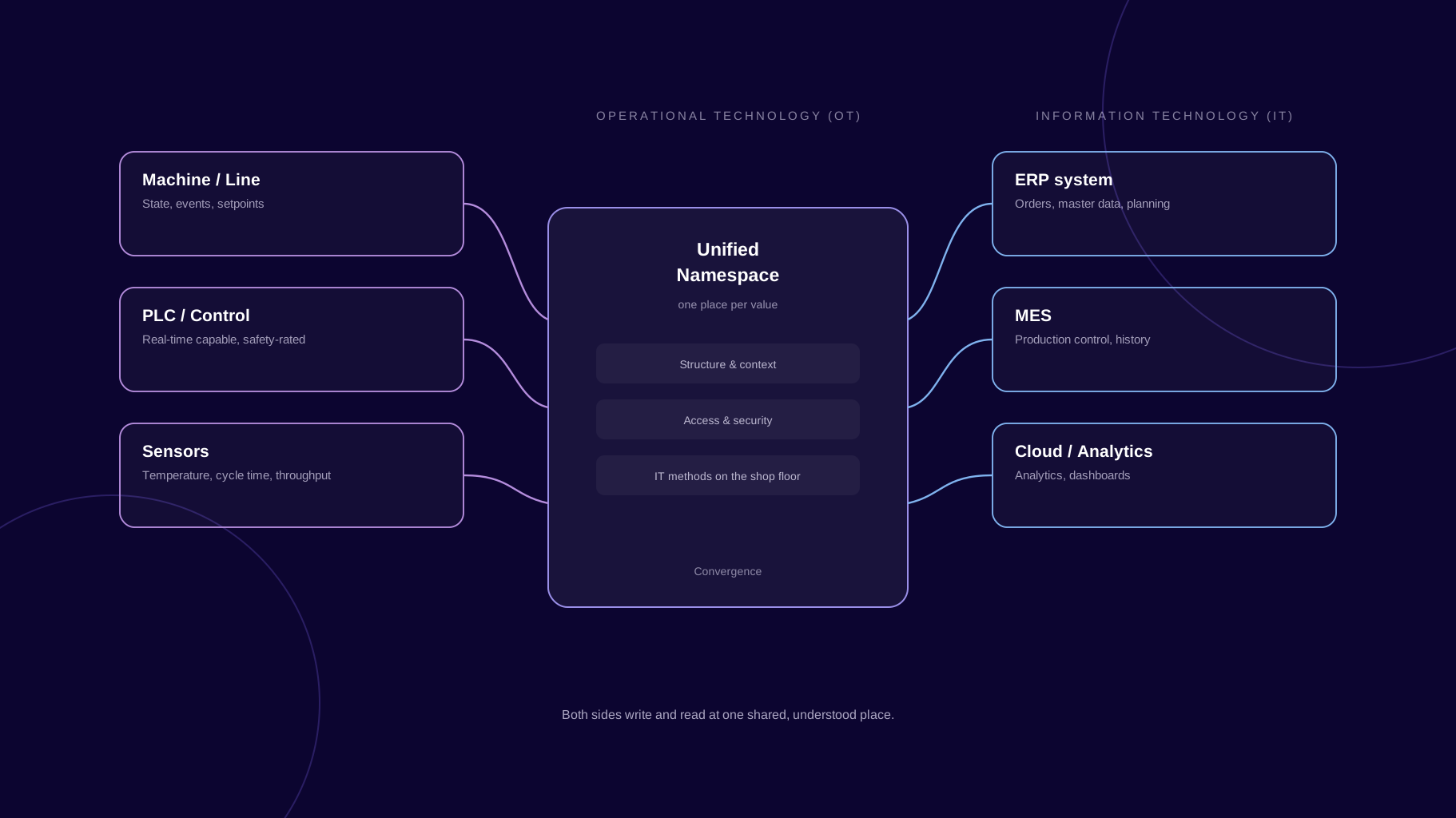
Where two worlds merge
The classic separation between production (OT) and administration (IT) is eroding fast, because isolated point solutions no longer hold up against the demands of modern markets. IT/OT convergence doesn’t just mean the technical connection of a machine to a network — it means the merging of two worlds that have so far spoken different languages, held different security standards and set different priorities. While OT relies on real-time capability and stability, IT contributes scalability and data analytics.
Convergence doesn’t mean either side gives way to the other. The controller remains responsible for safety and real-time behavior, the ERP system for orders and master data. What changes is the layer in between: it stops being a collection of individual connections and becomes a shared, understood structure.
Treat IT/OT convergence as a cabling question, and you get a network without order: every new connection is negotiated, documented and maintained individually. Convergence only becomes an architecture question once the structure behind it is fixed — and that structure then carries every individual connection.
The Unified Namespace as the connecting layer
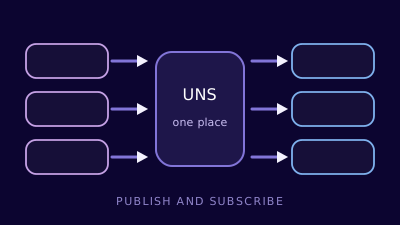
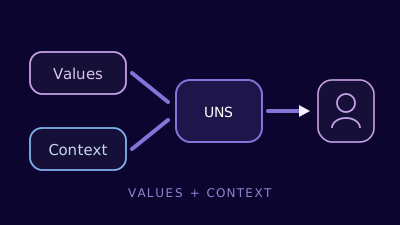
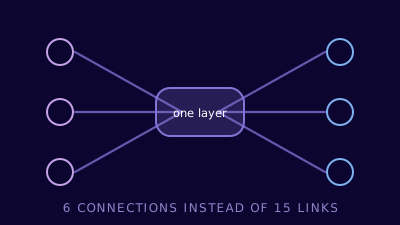
A key enabler for this merging is the Unified Namespace (UNS). It acts as the central instance where all data streams are structured under one consistent schema and made available in real time to every authorized participant. Instead of maintaining complex point-to-point connections that break with every change on the shop floor, the UNS creates a flexible architecture in which information is consumable and contextualized.
The difference from point-to-point coupling is a matter of numbers: six directly coupled systems produce fifteen connections, ten systems already forty-five. Instead, each new source writes to a fixed place in the namespace — and every system that needs it fetches it from there, without the source ever knowing who’s reading along.
More on how it’s built: What a Unified Namespace is and how it comes together.
IT methods on the shop floor
This shift requires a rethink within the organization: IT methods such as containerization and centralized management need to make their way onto the shop floor without compromising production’s autonomy. Only when data from deep inside the machine — sensors, PLCs — correlates seamlessly with the ERP system’s business logic does a genuine digital value chain emerge. Here, IT becomes a service provider to OT, massively increasing its efficiency through transparency.
In practice that means: edge runtimes that run locally in the plant but are centrally managed. Configuration as code instead of hand-maintained point solutions per machine. Versioning and rollback for the data connection too — not just for the control software.
Transparency instead of a black box
Ultimately, it’s about eliminating “shadow IT” on the shop floor and replacing it with professional, maintainable structures. Whoever lays the groundwork for clean convergence today secures the foundation for later AI applications and predictive maintenance. It’s the path away from “black-box production” toward a transparent, controllable company that can respond to market changes with agility.
Shadow IT doesn’t come from negligence, but from necessity: when the official connection is missing, every department solves its own data problem — with an export file, a script, a private dashboard. Each of these solutions works on its own and quietly breaks the next time a system changes.
The honest part
IT/OT convergence doesn’t solve an organizational problem by itself. Where responsibility for plant data is unclear, a shared data layer doesn’t change that at first — it just makes the ambiguity more visible. And convergence isn’t a one-off project: a structure nobody maintains ages just like any point-to-point connection, only slower and harder to notice.
Nor does it replace IT security on the shop floor. A shared namespace makes data available — who may access what is a separate question that needs its own answer. More on that on the page about cybersecurity and risk management.
Four stages
Convergence doesn’t happen in one step. The stages build on each other, and the most common mistake is skipping one.
Connectivity
Machines and equipment deliver data digitally — still as individual connections, still without a shared structure.
Shared namespace
A Unified Namespace organizes the data streams consistently. Individual connections become a structure every system can read the same way.
IT methods in the plant
Containerization, centralized management and versioning move onto the shop floor — without violating the controller’s real-time requirements.
End-to-end transparency
Shadow IT disappears because the official structure is faster than the workaround. Production turns from a black box into a controllable process.
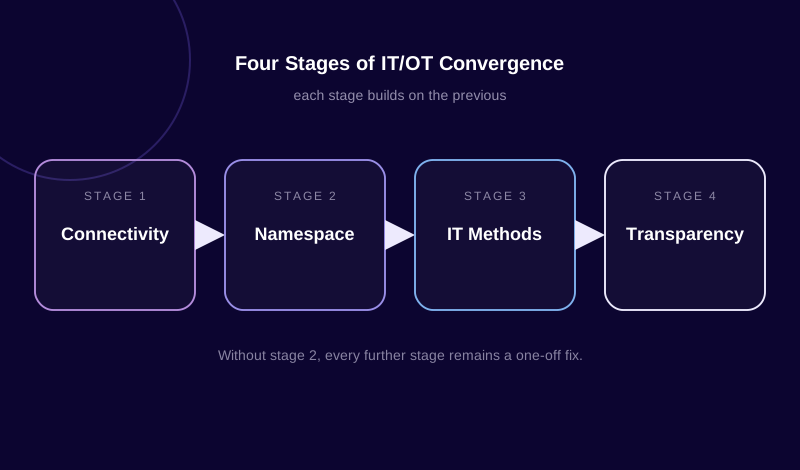
Connectivity, shared namespace, IT methods in the plant and end-to-end transparency follow as four stages.
IT/OT convergence with pronubes
With pronubes, you put exactly this strategy into practice: the platform acts as the scalable backbone that brings IT standards directly to the machine. Through integrated edge logic and straightforward UNS structuring, pronubes turns protocol chaos into an organized data landscape that’s ready to use immediately.
- pronubes Edge runs locally in the plant, translates between OPC UA, MQTT, REST, SQL and file formats, and buffers data when the connection drops.
- pronubes Zones maps sites, areas, systems and data flows hierarchically — the structure without which a shared namespace never scales past two machines.
- pronubes Insights makes connections, data streams and system states visible. A convergence whose data feed silently fails is more dangerous than no convergence at all.
More than 100 system types can be connected — from current IoT protocols to decades-old interfaces. More about the platform
- IT/OT convergence
- The merging of information technology and operational technology into a shared, mutually usable data landscape.
- Shop floor
- The production level itself — machines, lines, controllers — as distinct from administration and IT.
- Shadow IT
- Unofficial data solutions — export files, scripts, private dashboards — that emerge when the official connection is missing.
- Containerization
- Packaging software into isolated, portable units; enables centralized management even on distributed edge hardware.
- Unified Namespace
- An organizing principle that makes all of a company’s data sources available in one consistent, hierarchical structure.
- Edge logic
- Processing and translating data directly in the plant before it leaves the network — including buffering when the connection drops.
Frequently asked questions
Is IT/OT convergence the same as a Unified Namespace?
No. The Unified Namespace is one building block — the organizing principle that names both sides’ data streams consistently. Convergence is the broader process: it also includes organization, responsibilities, and the IT methods that arrive on the shop floor.
Does OT have to compromise on real-time behavior and safety for this?
No, that’s the most common misconception. The control level remains responsible for real-time behavior and safety; the shared data layer only reads along, without intervening in the control loop. What changes is the structure alongside it, not the controller itself.
Where do you start with IT/OT convergence?
With one machine that has a clearly scoped use case — but using the structural model that’s meant to apply to the whole plant later. Otherwise the first project just becomes another isolated solution instead of a reusable pattern.
What happens with existing equipment that has no modern interfaces?
It’s connected through existing paths: databases, file exchange, proprietary couplings or older protocols. The explicit goal is to let current IoT protocols and decades-old interfaces communicate in one shared language.
Does convergence automatically solve the shadow-IT problem?
Only if the official structure is faster to use than the workaround. A shared data layer that nobody maintains, or that’s slower than an Excel export, keeps getting bypassed. Convergence is an ongoing operational matter, not a one-off project.
pronubes is a product of inray Industriesoftware GmbH. Over 30 years of industrial software from Germany. Innovative and reliable for manufacturing companies.