
Cybersecurity and Risk Management for IT/OT Data Flows
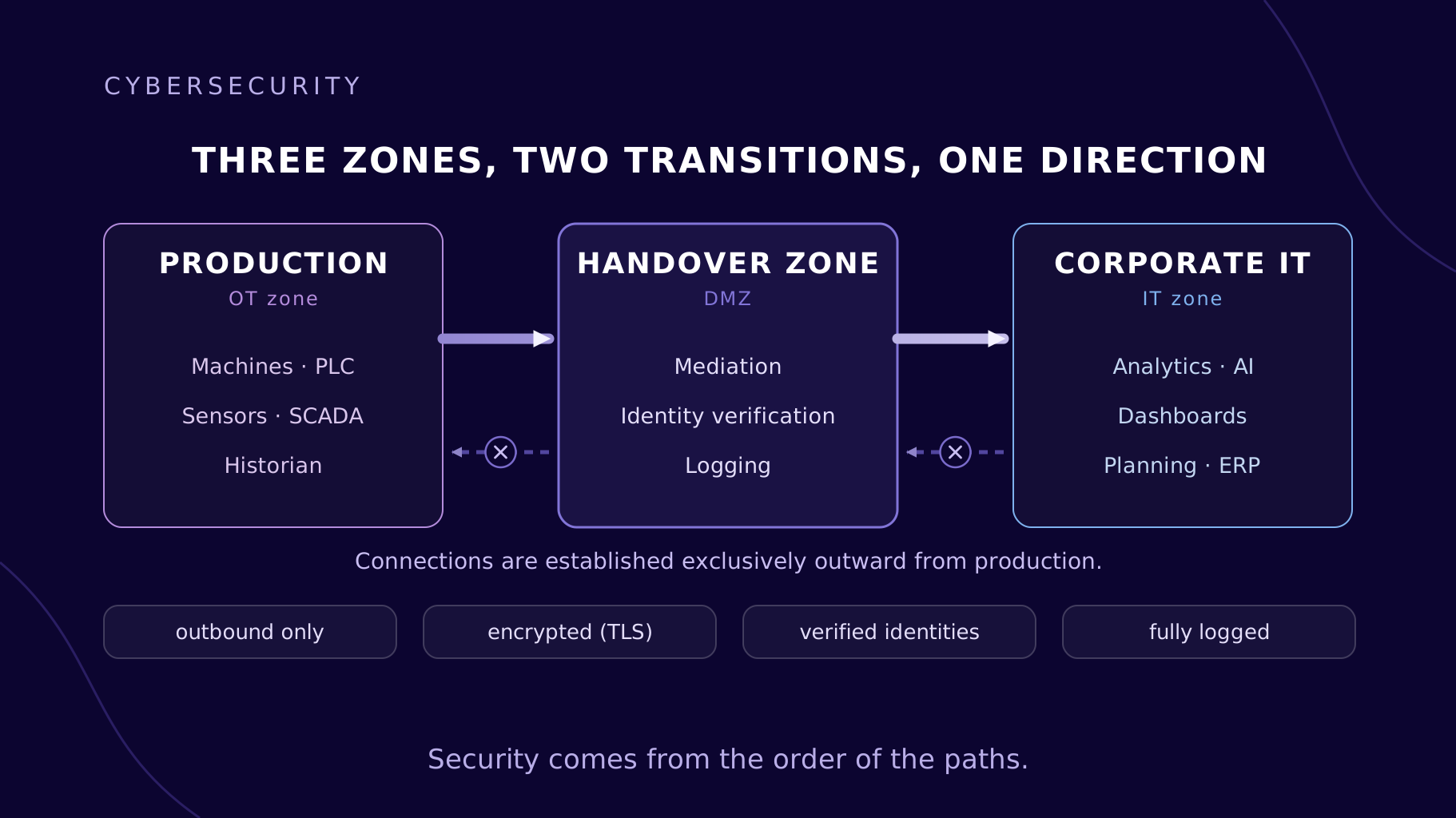
A data path between production and IT is secure when it uses few, named, and monitored routes: clearly separated zones, exclusively outbound connections from production, encrypted transport with verified identities, and a log that proves afterward what actually flowed. Security comes from the order of the routes, not from their number.
Starting point: two protection goals, one data path
Information technology and operational technology protect different things. IT protects the confidentiality and integrity of data first. OT protects the availability of the plant first — and with it, people, material, and schedule. A data path between the two must satisfy both goals, and in case of doubt, the plant wins.
That implies an uncomfortable rule: a security concept that opens up production for analytics purposes is not a compromise, it’s a mistake. The path runs the other way — production publishes outward; it is not queried from outside.
What actually happens
A cyberattack on a production plant rarely looks like it does in the movies. The three most common paths are unspectacular and have been the same for years:
- Remote access. A maintenance access point that stays permanently open, with an account known to multiple service providers. The most common entry point into ICS environments — Industrial Control Systems, meaning controllers, SCADA, and control systems.
- Ransomware via office IT. Encryption almost never starts on the plant floor but in the administrative network. Whether it reaches production is decided solely by the separation between the two — and in many plants, manufacturing then stops not because it was attacked, but because it has to be shut down as a precaution.
- Supply chain. A component, an update, or a third-party device brings along something nobody ordered. No perimeter helps against that — only the question of what a device is allowed to reach in the first place.
What’s notably missing from this list is the targeted attack on a controller. It happens, but it’s rare. The normal case is a path that someone opened for good reasons and then forgot about.
Zones, transitions, and network segmentation
The established ordering principle comes from the IEC 62443 series of standards. The core is described in IEC 62443-3-2 — Security Risk Assessment for System Design: the landscape is divided into zones with comparable protection needs, and all traffic between zones runs through a defined transition, called a conduit in the standard — few, named, monitored routes instead of many that grew organically.
In practice, the same thing is called network segmentation: the flat plant network is divided into sections, between which only what’s needed is permitted. The difference is one of perspective — zones and conduits describe the protection need, segmentation describes the implementation in the network. Anyone who equates the two skips the decisive step: first it’s determined what belongs together and what needs protecting, then the cutting happens.
The layer logic behind this is older than the standard and still known in many plants as the Purdue model: field level, control level, supervisory level, operations management level, enterprise level, with a DMZ in between as a buffer zone between production and office IT. You don’t have to adopt the model to create zones — but it answers the question of where the DMZ belongs.
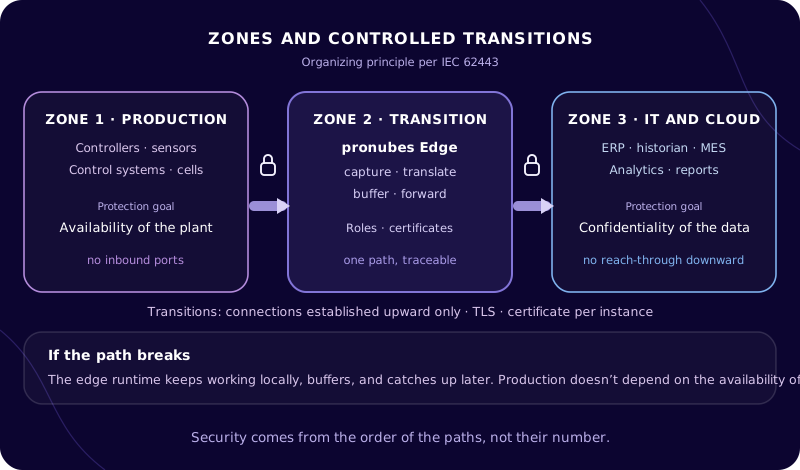
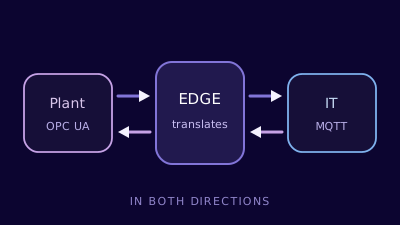
Three zones, two transitions, one direction: production publishes, it is not queried.
In practice, this means: no inbound port leads into the production zone. The local runtime in the transition zone retrieves values from the plant and itself establishes an outbound, encrypted connection upward. If this connection fails, it buffers and delivers later — production doesn’t depend on the availability of the central system.
Four principles for secure data flows
-
One direction
Connections are established from the zone that needs more protection outward, never into it. A return path for instructions exists — but as its own explicitly approved channel, not as an open port.
-
Few routes
The fewer transitions there are, the more completely they can be audited. A shared layer replaces a growing number of bilateral connections that nobody fully understands anymore.
-
Verified identities
Every connection authenticates itself — via certificates, not shared passwords. Rights are granted by role, and revoking a right takes effect immediately and everywhere.
-
Traceability
It can be determined afterward which source delivered what and when, and where a gap occurred. Without this evidence, neither an incident can be investigated nor an audit passed.
Risks and what actually counters them
| Risk | Typical cause | Countermeasure |
|---|---|---|
| Unplanned access to the plant | inbound permission granted for an analytics purpose | exclusively outbound connections, zone transition instead of port opening |
| Unknown routes | point-to-point connections that grew over years | inventory, consolidation onto a few transitions, ongoing visibility |
| Shared credentials | one service account for multiple connections | certificates per instance, roles instead of shared accounts |
| Silent failure | source stops delivering, nobody notices | heartbeat and age per data stream, alert on absence |
| Third-party access during remote maintenance | permanently open maintenance access | time-limited, logged access |
| Data loss during disruption | no buffering at the plant | store and forward with later delivery |
Who will maintain the connection between Plant 4 and the ERP system in five years — and what happens when the person who built it leaves? A data path without a named owner is a risk regardless of its encryption.
Proof and regulatory framework
The pressure is shifting from the measure to the proof. Three references are decisive here:
- IEC 62443 describes security for industrial automation systems — among other things via zones and transitions as well as graduated security levels. It provides the language in which architecture decisions can be justified.
- NIS2. According to the BSI (Germany’s Federal Office for Information Security), the German NIS2 Implementation Act took effect on December 6, 2025. The risk management obligations are set out in Sections 30 ff. BSIG (Germany’s BSI Act); supply chain security is explicitly named there (Section 30(2) No. 4 BSIG). Affected organizations register via the BSI’s portal. In the event of a significant security incident, a three-stage reporting chain applies: an initial report within 24 hours, a follow-up report within 72 hours, and a final report no later than one month afterward.
- BSI fundamentals. For concrete implementation, the ICS Security Compendium and the IT-Grundschutz module on industrial IT are the most practice-oriented German-language sources. Where an information security management system under ISO 27001 already exists, it covers a substantial part of the organizational requirements — the OT-specific points are added on top, they don’t replace it.
For the architecture, this implies above all one thing: what isn’t documented and observable can’t be proven. Visibility is therefore not a convenience feature but part of the obligation.
This section provides context and does not replace legal advice. Clarify whether and how your company is affected with your compliance function; the BSI’s guidance and the statutory text are authoritative. Information current as of: September 2026.
How pronubes secures the path
- pronubes Edge runs locally at the plant, establishes outbound connections, and buffers on connection loss — no inbound access into the production zone.
- Secure by Design as a principle: certificates, roles, telemetry only by opt-in, SBOM-capable and Vault-ready.
- pronubes Insights makes connections, data flows, and system states visible — including the flows that go silent.
- pronubes Zones records which flow belongs to which site, area, and system — the basis for being able to assign responsibility in the first place.
- IEC 62443
- Series of standards for the security of industrial automation and control systems; works with zones, transitions, and graduated security levels.
- Zone / Conduit
- An area with comparable protection needs and the defined path through which traffic between two zones runs; described in IEC 62443-3-2.
- ICS
- Industrial Control Systems: the controlling systems of a plant — controllers, SCADA, control systems, operator interfaces.
- Network segmentation
- Division of a network into sections between which only explicitly permitted traffic is possible — the network-side implementation of the zone concept.
- Purdue model
- Layer model of manufacturing IT from the field level to the enterprise level; places the DMZ between production and office IT.
- NIS2
- European directive on network and information security with requirements for risk management, reporting channels, and management liability.
- SBOM
- Software Bill of Materials: a machine-readable inventory of the components contained in a product, the basis for vulnerability assessment.
- Store & Forward
- Buffering data during a connection interruption and delivering it later once the connection is restored.
Frequently asked questions
Doesn’t a data platform inevitably open up production?
Not if the direction is right. The local runtime reads from the plant and establishes the connection upward itself. No inbound port leads into the production zone; a return path for instructions is its own, explicitly approved channel.
What happens if the central instance fails?
The edge runtime keeps working locally and buffers data that can’t flow out. Once the connection is restored, it’s delivered afterward. Production therefore doesn’t depend on the availability of the central system.
How do we handle legacy equipment without modern security features?
They aren’t replaced, they’re enclosed: the equipment stays in its zone, the connection uses existing paths, and the security functions live in the transition — where they can be maintained and updated.
Who operates the transition — IT or OT?
A division has proven effective: the local runtime at the plant sits close to OT, while the structural model and operational view sit centrally with IT. What matters is that the division is explicitly made and documented — a path without an owner is the real risk.
Is encryption enough?
No. Encryption protects the transport. Identity, authorization, the direction in which the connection is established, and traceability remain open questions. An encrypted but inbound access point into the production zone is still an inbound access point.
Secure data flows that also get audited.
30 minutes about your system landscape: where the risks lie today and how data flows can be made secure.
pronubes is a product of inray Industriesoftware GmbH. Over 30 years of industrial software from Germany. Innovative and reliable for manufacturing companies.