
What is a digital twin in production?
A digital twin is the continuously updated digital representation of a real machine, line, or plant. It connects live values from operational technology with master data from information technology — design, maintenance plan, order — and holds both together in a shared structure. What matters is not the visualization, but whether the representation is current, contextualized, and operable.
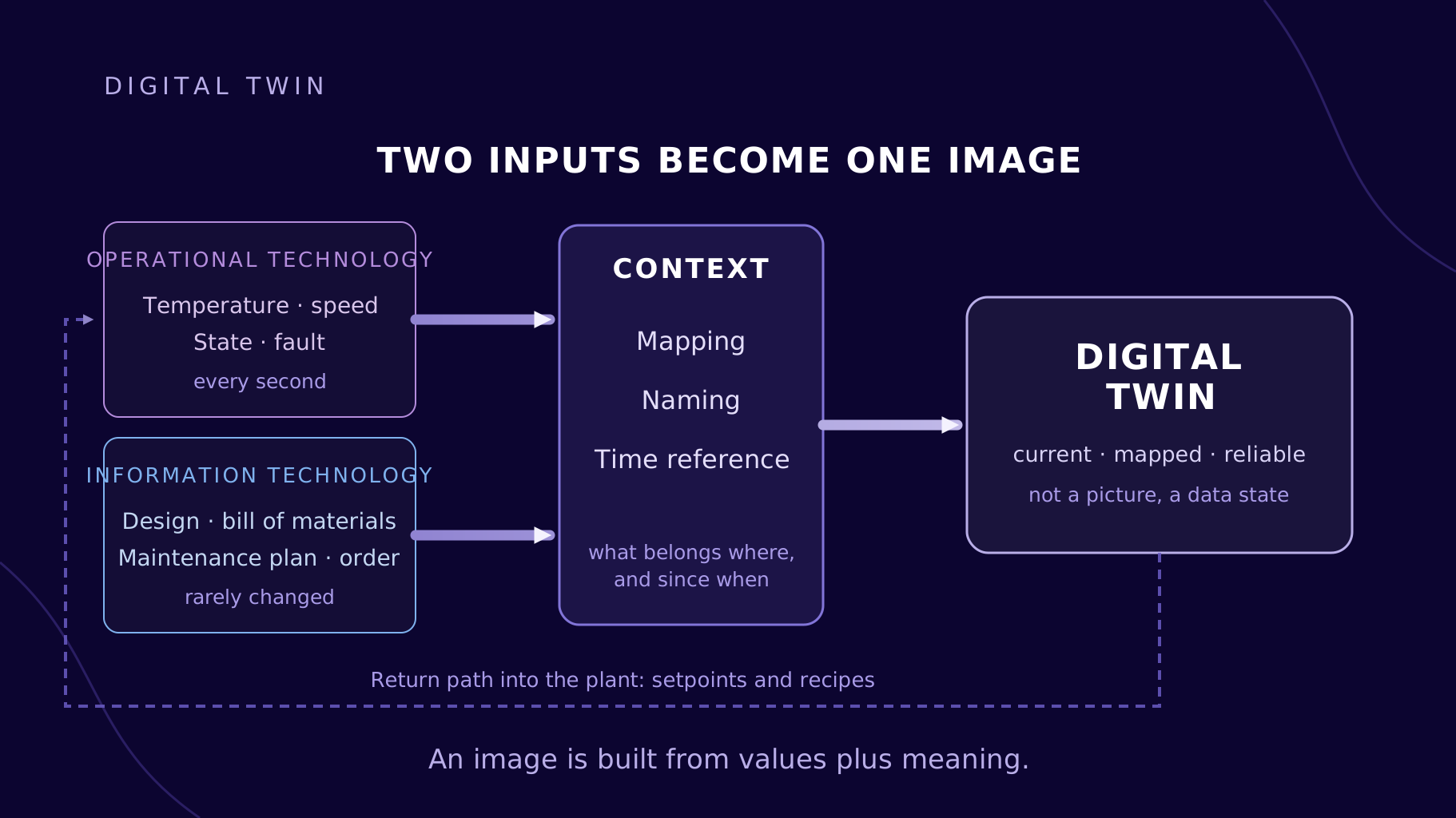
Definition: digital twin
A digital twin is the digital counterpart of a real object — a machine, a line, a plant — that is continuously supplied with data from ongoing operations. It provides information about the state, history, and performance of the original without anyone needing to check on site.
The difference from a model comes down to a single word: continuous. A model describes a state. A twin describes the current state and knows the path that led there. Without a continuous data flow from operational technology, a twin remains a drawing with a timestamp.
“Continuous” does not necessarily mean real time in the control-engineering sense. What matters is that the currency of the data fits the use case and is known: seconds for process diagnostics, minutes for maintenance decisions. Within the Industry 4.0 discussion, the digital twin is therefore less a technology than a requirement on the data landscape beneath it.
A twin is not a product you buy, but a property of the data landscape. It emerges where values flow reliably and are unambiguously assigned. Anyone who introduces one without this foundation gets a surface that nobody maintains.
3D model, simulation, twin — three different things
These three terms are regularly mixed up in projects. They differ mainly in how current their data is and what they are good for.
| Data currency | What it is good for | What is missing | |
|---|---|---|---|
| 3D model | design state | Geometry, assembly, training | state of the real unit |
| Simulation model | assumed parameters | Design, upfront what-if analysis | connection to the real plant |
| Digital shadow | real-time data from operations | Observing, analyzing, reporting | the path back into the plant |
| Digital twin | ongoing operation, in both directions | Diagnosis, comparison, prediction in operation | nothing — as long as the data flow is running |
The most important and most frequently overlooked distinction is between a digital shadow and a digital twin. A digital shadow is fed from the plant in real time but does not act back on it: it shows what is happening. A twin closes the loop — insights from the representation flow back as instructions into the line and its controls. Anyone who does not draw this line is selling a dashboard as a twin.
In practice, the twin is often the bracket that holds it all together: it uses geometry from the model, computes with the methods of simulation, and lays the actual values of the plant underneath.
Four types of digital twins
The common breakdown follows the scope of observation. It is useful because it answers the question of data requirements at the same time: the larger the scope, the more sources must run in sync.
| Type | Scope of observation | Typical question |
|---|---|---|
| Component twin | a single part | How worn is this bearing? |
| Asset twin | a machine made of several components | How do the parts work together? |
| System twin | a line or plant made of several assets | Where is the bottleneck? |
| Process twin | the interplay of several systems in the plant | What happens if we retool? |
The levels build on each other: a process twin without solid asset twins beneath it is just an assumption with a surface.
Why context determines the value
A temperature reading is worthless on its own. It only becomes usable once it is clear which unit supplied it, in which plant and area that unit stands, which order it relates to, and what setpoint was intended for it. This assignment is called context — and it is the actual building block of the twin.
Context does not arise in the plant. It arises in a structure that brings together values from operational technology with master data from information technology and names both consistently. A Unified Namespace is exactly the ordering principle for this: it gives every value a place that reads the same across all systems.
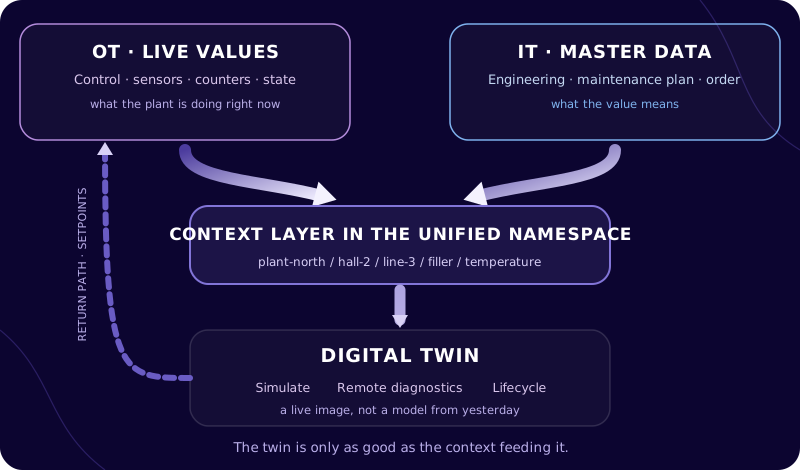
The twin does not emerge from the plant alone — it emerges from values plus meaning.
Four maturity levels — and why none gets skipped
The levels build on each other. The most common reason a twin project fails is jumping from level 1 to level 3.
-
Representation
State values of the plant are digitally available and mirrored. You can see what is happening — but not yet why.
-
Context
Live values are linked to master data: plant structure, setpoints, maintenance plan, order. Numbers become statements.
-
Prediction
Scenarios can be computed on the representation: parameter changes, loads, failure consequences — without risk to the real hardware.
-
Feedback
Results don’t stay in the dashboard. Instructions, recipes, and limit values flow back in a controlled way into the line and its controls.
Where a twin pays off in production
- Fault diagnosis without a site visit. State, history, and events sit in one place. Anyone who knows the plant does not need to be near it to make a judgment.
- Test changes in advance. A changed procedure is first tested on the representation and then implemented in reality. That shortens downtime and limits the risk of damage.
- Condition-based maintenance. Maintenance follows actual wear, not the calendar.
- Comparison across sites. Two identical lines can only be compared if their values are named the same way. The twin enforces this naming.
- Knowledge survives staff turnover. What today sits in people’s heads and notes becomes a queryable structure.
What data a twin requires
The technology behind the representation is rarely the problem. The problem is the data feeding it.
- Reliable cadence. Values must arrive at a known frequency — and it must be noticeable when they stop.
- Unambiguous identity. Every source belongs to exactly one object in the structure. Duplicate or changing identifiers invalidate every evaluation.
- Time reference. Without reliable timestamps, no history and no comparison can be computed.
- Legacy plants included. Plants with twenty years of remaining service life are not replaced for a data project. They must be connected via whatever interfaces they have.
- Clear ownership. If nobody owns the data path, it doesn’t get operated — only repaired.
Standards and reference models
The term is now standardized, which considerably eases tenders and supplier discussions.
Three references carry the practice:
- ISO 23247 — Automation systems and integration — Digital twin framework for manufacturing. The series describes the fundamentals in Part 1, a reference architecture in Part 2, the digital representation of manufacturing elements in Part 3, and information exchange in Part 4; 2026 added Part 5 on the digital thread and Part 6 on composing multiple twins.
- IEC 63278-1:2023 — Asset Administration Shell for industrial applications. The Asset Administration Shell is the standardized wrapper in which the characteristics and data of an asset are described independently of manufacturer. It is the core of the debate in German-speaking discourse and the bridge between design and operational data.
- IEC 62541 (OPC UA) and IEC 62264 (the international version of ISA-95) provide the transport and structure that a twin in the plant builds on.
What matters most in practice is this: anyone who aligns the structure of their plant data with these models can later switch twin vendors without having to recollect the data.
How pronubes feeds the representation
pronubes does not deliver the twin, but the streams it is built from — in the structure and quality that an evaluation can rely on. ERP, MES, and the historian remain authoritative for their respective tasks.
- pronubes Edge runs locally in the plant, translates between OPC UA, MQTT, REST, SQL, and file formats, and buffers data if the connection is lost.
- pronubes Zones maps sites, areas, systems, and data flows hierarchically — the naming without which a twin cannot scale beyond two plants.
- pronubes Insights makes connections, data streams, and system states visible. A representation whose feed silently fails is more dangerous than none at all.
Over 100 system types can be connected — from current IoT protocols to decades-old interfaces. More about the platform
- Digital twin
- Continuously updated digital representation of a real object, fed from ongoing operations, with feedback to the original.
- Digital shadow
- Representation fed from operations but without feedback to it — the precursor to the twin.
- Asset Administration Shell
- Standardized description wrapper for Industry 4.0 components per IEC 63278-1; organizes an asset’s characteristics and data independently of manufacturer.
- Contextualization
- Assignment of a measured value to location, plant, order, setpoint, and time — the prerequisite for any evaluation.
- Unified Namespace
- Ordering principle that makes all of a company’s data sources available in a single, hierarchical structure.
- OPC UA
- Manufacturer-independent standard for data exchange in automation, including security mechanisms and an information model.
Frequently asked questions
Do I need a 3D model for a digital twin?
No. Geometry is one possible visualization, not part of the definition. Many twins in productive use consist of structure, metrics, and trends — entirely without 3D. A model helps where spatial relationships need to be explained.
Where do I start if several plants are affected?
With one plant that has a clearly scoped use case — but with the structural model that should later apply to all of them. That way the first project becomes a reusable pattern instead of an isolated solution that has to be broken apart again during rollout.
How current does the representation need to be?
That depends on the use case. Minutes are often enough for maintenance decisions, seconds are needed for process diagnostics, and less than that for control tasks. What matters is not the smallest possible value, but that the frequency is known and monitored.
What happens if the connection fails?
The edge runtime keeps working locally and buffers data that cannot flow out. Once the connection is restored, it is delivered afterward. The twin then has a gap in its history, but no incorrect values.
Do old plants need to be replaced?
No. Legacy plants are connected via existing means: databases, file exchange, proprietary couplings, or older protocols. The explicit goal is to let modern IoT protocols and decades-old interfaces communicate in a shared language.
A twin that holds up in operation, too.
30 minutes about your system landscape: what data foundation a digital twin really needs.
pronubes is a product of inray Industriesoftware GmbH. Over 30 years of industrial software from Germany. Innovative and reliable for manufacturing companies.