
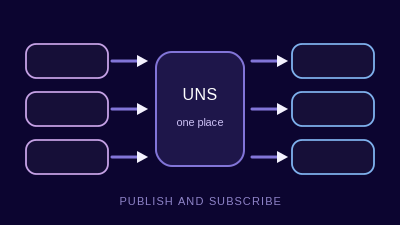
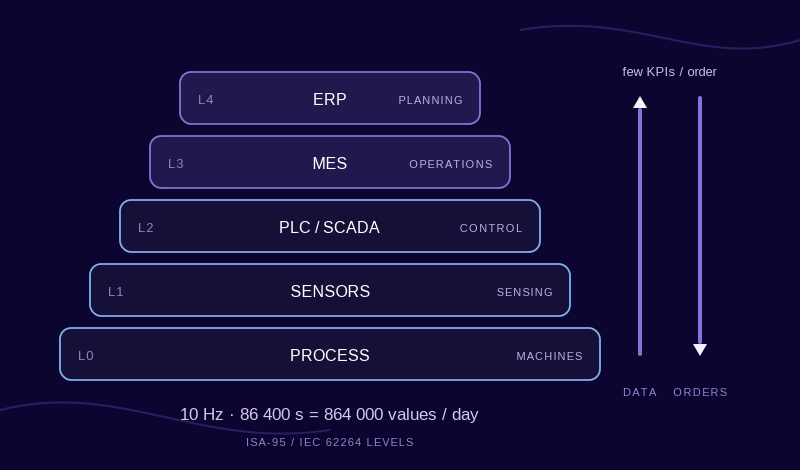
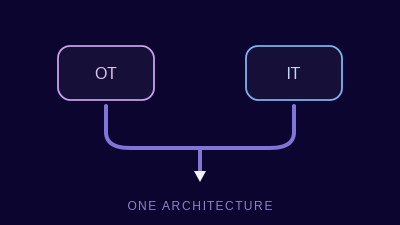
A Unified Namespace (UNS) does not replace vertical integration, it complements it. Production-critical processes such as production orders, recipes and confirmations run directly and synchronously between ERP, MES, SCADA and the controller, with a confirmation that the order has arrived at the machine. Live data for reporting, BI and AI runs asynchronously through the UNS, usually via an MQTT broker. Both paths need the same context: which product, which order, which machine, which point in time. The Unified Namespace is a shared, hierarchically named data space in which sources publish their current state and consumers subscribe to it. Vertical integration connects the levels of a plant from sensors to enterprise management. The recommendations for implementing the strategic initiative Industrie 4.0 (Forschungsunion and acatech, final report of 8 April 2013) name it as one of the three characteristics of Industrie 4.0. Both approaches move production data, but in different ways and for different purposes. The UNS is often described as a replacement for the automation pyramid. The level model behind it, however, is older and still valid. The Purdue reference model for computer-integrated manufacturing was published by the Instrument Society of America in October 1989. ANSI/ISA-95 builds on it; its first part appeared in 2000 and was adopted internationally as IEC 62264-1 in 2003. MES systems have always exchanged orders and confirmations with context, without a UNS. Context is therefore not a feature of the UNS but part of every integration. A simple example shows why confirmation matters for orders. A line produces one part every 30 seconds. A new recipe is distributed only through the broker, and the receiving service at the machine is disconnected for five minutes. In that time, 300 / 30 = 10 parts are made with the old recipe without ERP or MES knowing about it. With a handshake, the missing confirmation becomes visible immediately. The values are assumed. The example shows why production-critical flows need a business-level confirmation. Both paths consist of a small number of well-described building blocks. Four mechanisms determine which path fits. The sequence is similar in most projects. Which flows control production, and which serve analysis and monitoring? Critical processes stay on the direct path. Topic structure, naming and mandatory attributes are agreed bindingly before the first values flow. Orders, recipes and confirmations run with a handshake between ERP, MES, SCADA and controllers. Values with context are published to the broker. The broker is secured and monitored like any other production system. Four rules prevent the most common mistakes. These points slow down projects with UNS and vertical integration most often. Two paths mean two things that have to be operated: direct connections and a broker. A plant that only exchanges orders and confirmations between ERP and machines and has no further consumers can manage with vertical integration alone. A UNS pays off when many systems need the same live data. pronubes is a vendor-agnostic data integration platform and serves both paths. Integration with the vertical OT and IT systems runs directly through pronubes. At the same time, pronubes publishes and subscribes to topics in the MQTT broker, according to the defined data model and topic structure of the UNS. The product components have different tasks. No. The UNS complements it. Production-critical processes with confirmation continue to run directly between ERP, MES, SCADA and controllers. The UNS distributes live data to reporting, BI and AI. Technically this is possible. What is missing, however, is the business-level confirmation that the machine has accepted the order. For orders and recipes, the direct path with a handshake is the safer choice. No. MES systems have exchanged orders and confirmations without a UNS for decades. A UNS pays off in addition when many further systems need the same live data. A handshake is the confirmation that an order or specification has arrived at the machine. Only then does the sending system know that it can proceed. By classifying data flows by criticality and agreeing on a binding data model. Then the critical flows are connected directly and the live data is published into the UNS. pronubes connects ERP, MES, SCADA and controllers directly and at the same time supplies your Unified Namespace with live data.Unified Namespace or vertical integration: what goes where?
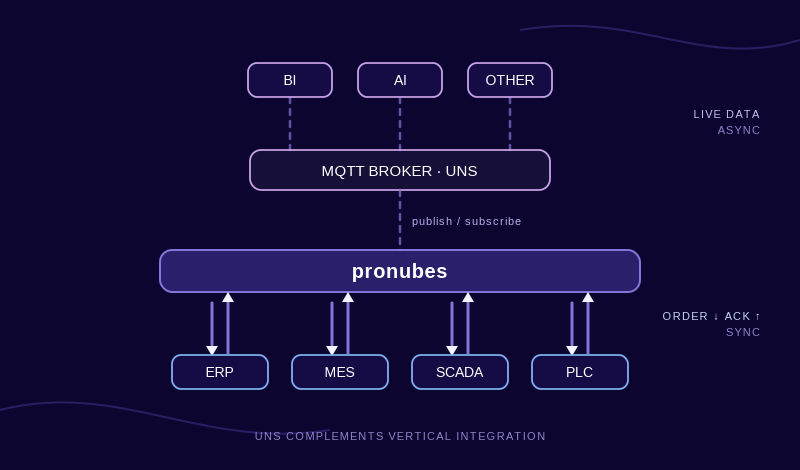
Definition: two paths for production data
Characteristic
Vertical integration
Unified Namespace
Communication
Direct connection, synchronous
Publish/subscribe through a broker, asynchronous
Confirmation
Handshake: the target system confirms that the order has arrived
The broker delivers, there is no business-level confirmation from the receiver
Typical data
Production orders, recipes, confirmations, quality data
Measured values, states and events for reporting, BI and AI
Criticality
Production-critical, 24/7
Not production-critical
New consumers
New interface or new mapping
Subscribe without any change at the source
Why the question arises
The building blocks of both paths
Building block
Task
Origin
MQTT broker
Receives published messages and delivers them to all subscribers
MQTT 3.1.1, OASIS standard since 29 October 2014
Retained messages
Keep the last known message per topic for new subscribers
RETAIN flag in MQTT 3.1.1
Topic hierarchy
Orders data by enterprise, site, area, line and cell
Equipment hierarchy according to ISA-95 / IEC 62264-1
Message structure
Gives MQTT messages a fixed format for states, measurements and heartbeats
Eclipse Sparkplug 3.0, published as ISO/IEC 20237 in November 2023
Integration platform
Connects ERP, MES, SCADA and controllers directly, with request and reply
Request-reply pattern according to Hohpe and Woolf, Enterprise Integration Patterns, 2003
How both paths work technically
Four steps to the right split
Classify data flows by criticality
Define the data model first
Secure the direct connections
Publish live data into the UNS
What should not run through the UNS
Typical hurdles in practice
How pronubes supports
Frequently asked questions
Does a Unified Namespace replace vertical integration?
Can orders be sent to the machine via MQTT?
Does vertical integration need a UNS?
What does handshake mean in production?
Where do you start?
Two paths, one platform.
pronubes is a product of inray Industriesoftware GmbH. Over 30 years of industrial software from Germany. Innovative and reliable for manufacturing companies.