
Separation of concerns in industry
- Separation of concerns reduces complexity in Industry 4.0 systems.
- Old architectures are inflexible and create data silos.
- pronubes consistently decouples IT and OT systems.
- The result: scalable, data-driven production.
Different roles and objectives
In Industry 4.0, short product cycles, complex processes, and rapidly changing production conditions are typical. To maintain clarity and structure in these areas, the separation of concerns (SoC) is an important principle. SoC makes it possible to focus on individual aspects, such as security, correctness, or efficiency, without losing sight of the big picture.
“SoC helps to organize and control complex systems.”
The problem with old architectures
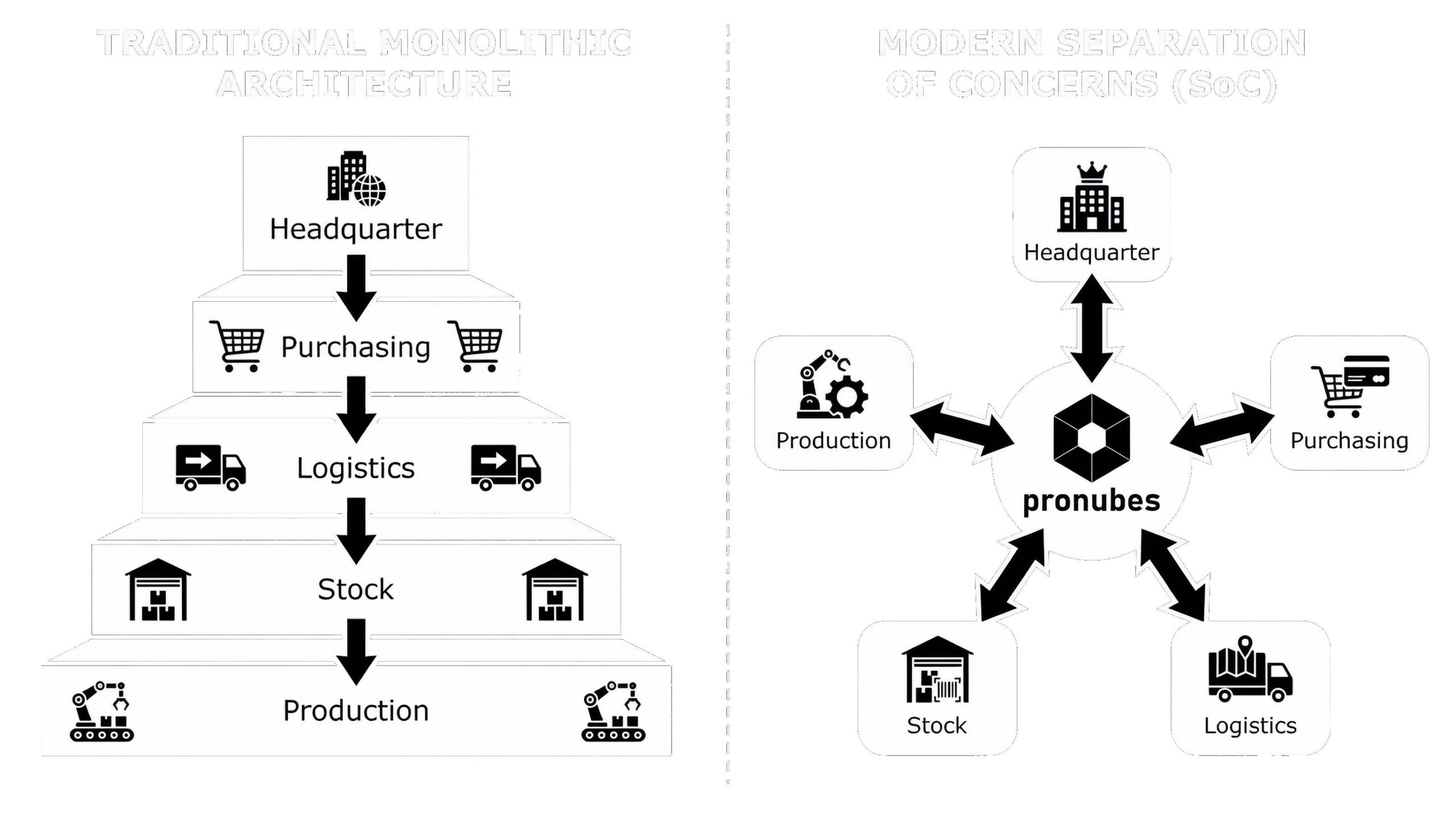
In many cases, there used to be a clear IT hierarchy in manufacturing, often known as an information pyramid. Although this helped to distribute responsibility for IT systems, it had a number of disadvantages:
1. Fixed connections:
Complex connections arose between the various IT systems (such as ERP and MES) and the machines (PLC, sensors). This made it complicated and costly to integrate new data sources.
2. Data silos:
Information was usually collected in a strictly hierarchical manner, which prevented a comprehensive view. Data remained stored in individual islands, making it difficult to use complex and fast data analyses.
Conclusion: These old models are unsuitable for modern, data-driven factories that need to react quickly and constantly evolve.

SoC in modern manufacturing
pronubes uses separation of contents to break down these rigid structures and create a flexible architecture that is fit for the future:
1. Flexible system integration:
pronubes relies on a service-oriented architecture (SOA). This involves packaging and simplifying the technical systems and their functions into what are known as value-added services. This bundles the technical complexity in the integration layer. As a result, applications and services can be developed independently of each other and at different speeds without compromising compatibility. This is the basis for the flexible integration of different IT and OT systems.
2. Modular control:
SoC is also used in machine control, for example in multi-agent systems. Each agent is responsible for a specific component or machine (e.g., the robot or the press). The control logic is thus clearly separated from the implementation details of the production cell. This makes the agent programs simpler, more heterogeneous, and easier to maintain.
3. Transparency and reliability:
In addition to system integration, overarching issues such as data quality and data management must also be addressed separately. Since fact-based decisions depend on high data quality, a system must ensure that data quality is measured and improved across all analysis steps, from the source to the end user.
Through consistent separation with SoC, pronubes provides greater transparency in complex production networks and enables perfect collaboration between humans, machines, and systems in the smart factory.
Make your production data-driven
pronubes connects IT and OT systems in one place, simplifies integration through standards such as OPC UA, MQTT, or REST, and ensures high transparency with real-time data. The scalability and open architecture of pronubes provide the basis for future-proof production systems and enable data-driven production.
Get in touch, try pronubes for free, and find out how pronubes can improve your processes.
You may also be interested in

Scaling in industry
Read our article to find out everything you need to know about scaling and how you can benefit from it in industry.

Agility and flexibility for IT strategies with pronubes
Read our article to find out how pronubes brings agility and flexibility to IT strategies, revolutionizing your IT strategies.
Reliability with pronubes
Stable processes and fewer downtimes are crucial for industry. How pronubes contributes to this.