
IT (Information Technology) processes information: computing, storing, communicating. OT (Operational Technology) monitors and controls physical processes: machines, equipment, sensors. The most important difference is not the technology itself, but the order of security priorities: IT classically ranks confidentiality above availability; OT, as defined by the US National Institute of Standards and Technology in Special Publication 800-82, ranks them the other way around — availability above confidentiality. A production stop weighs more heavily there than a delayed response to a request. For manufacturing companies, that means security and operating practices cannot simply be carried over unchanged from one side to the other. IT (Information Technology) covers systems that process, store, and transmit information: servers, databases, networks, office applications. OT (Operational Technology) covers systems that monitor or control physical equipment and processes: programmable logic controllers (PLCs), supervisory systems (SCADA, DCS), sensors, and actuators. The authoritative definition comes from the US National Institute of Standards and Technology (NIST). Special Publication 800-82, published in September 2023 in its third and currently valid revision as the “Guide to Operational Technology (OT) Security,” describes OT as hardware and software that directly monitors or controls physical devices, processes, and events, and sets it apart from classic IT and its own security priorities. IT security has followed a fixed order among its three classic goals for decades: confidentiality over integrity over availability. In this logic, a data breach weighs more heavily than brief downtime — customer data that is once exposed cannot be pulled back. NIST SP 800-82 describes the opposite priority for OT: availability over integrity over confidentiality. A stopped line costs production immediately; a controller processing the wrong values can cause scrap or damage; in the worst case, people’s safety is at stake. Anyone who assumed confidentiality ranked first there too, the way it does in IT, would set the wrong priorities — for instance, pushing a security patch outside a planned maintenance window and halting the line to close a theoretical vulnerability. This reversal is not a clash between two worldviews; it follows directly from what actually happens when each side fails. Beyond security priorities, IT and OT differ in practically every operational question: Which systems are clearly IT, which are clearly OT, and where is the boundary still unclear today — say, a Windows machine that operates a piece of equipment? Systems with comparable protection needs are grouped into zones, connected through defined crossings instead of one shared, flat network. Who patches what, and who responds to an incident right at the boundary between the two sides? Without a clear answer, any technical separation stays incomplete. Monitoring across both sides shows where data actually flows — without dissolving the boundary itself. Strict separation protects, but it also blocks the analysis that only comes from combining data — one reason namespaces and data lakes exist for production data in the first place. The goal is controlled exchange through defined, monitored crossings, not isolation for its own sake. And not every plant needs the same depth of segmentation: an office building’s air conditioning demands less than a safety-relevant controller. pronubes is the platform between the shop floor and IT — sitting right at the boundary this page is about. That keeps the boundary between IT and OT intact — while still leaving it open enough for the analysis both sides need. More on the platform No, but the two belong together. Convergence describes controlled data exchange across a maintained boundary — not dissolving that boundary. Clean separation is what makes convergence safe in the first place. Because a production stop has immediate, often physical consequences — lost output, equipment damage, in the worst case harm to people — while a confidentiality breach in IT usually carries economic or legal consequences without physical danger. Usually not. An update can throw a running line out of sync; most OT patches are therefore only applied during a planned maintenance window, not rolled out automatically the way IT patches typically are. A buffer zone holding systems that are allowed to talk to both networks — a historian or a data export, for instance — without connecting the office network and the production network directly. Historically, maintenance and automation engineering; increasingly, jointly with IT security — bringing its own expertise for the reversed priorities, not treated as a side task of the regular IT department.What Is the Difference Between IT and OT?
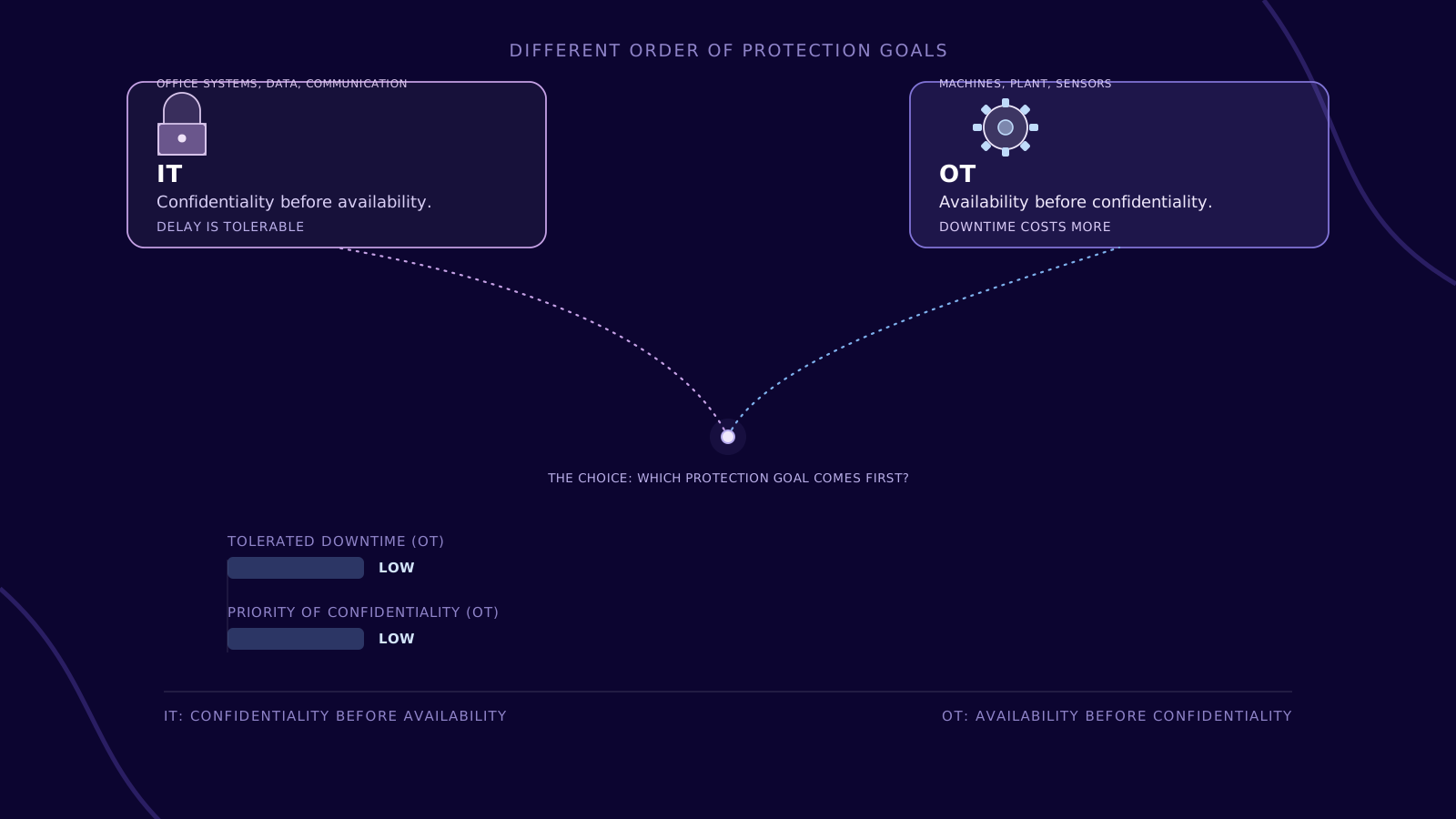
Definition: IT and OT
Trait
IT
OT
Purpose
process information
control and monitor physical processes
Typical systems
servers, databases, office applications
PLCs, SCADA, DCS, sensors, actuators
Owned by
IT department
maintenance, automation engineering
Why the security priorities reverse
IT and OT compared
Trait
IT
OT
Priority order
confidentiality > integrity > availability
availability > integrity > confidentiality
Lifecycle
typically three to five years
often the full service life of a plant, not uncommonly two decades or more
Updates
regular, often automated
planned, usually only during a maintenance window with the line stopped
Protocols
TCP/IP, HTTP, SMB
Modbus, PROFINET, OPC UA, proprietary fieldbuses
Real-time requirement
usually not time-critical
often hard real-time, in the millisecond range
Failure consequence
data loss, productivity impact
production stop, equipment damage, in extreme cases harm to people
Examples in practice
What the separation technically runs on
Four steps to drawing the boundary
Take stock
Segment the network into zones
Assign ownership
Establish visibility
What IT/OT separation is not
Common pitfalls in practice
How pronubes mediates between IT and OT
Frequently asked questions
Is IT/OT separation the same thing as IT/OT convergence?
Why does OT prioritize availability over confidentiality?
Can OT systems be patched the same way as IT systems?
What is a DMZ between IT and OT?
Who is responsible for OT security?
 What Is IT/OT Convergence? The other side of the same boundary Keep reading
  Cybersecurity in Industry What NIS2 and IEC 62443 actually require Keep reading
  Interoperability in Industry Why connectivity matters more than any single system Keep reading
 A boundary you know about, not one you discover during an incident.
30 minutes on your system landscape: where IT and OT blur together today, what clean segmentation looks like, and where it fails in practice.
pronubes is a product of inray Industriesoftware GmbH. Over 30 years of industrial software made in Germany. Innovative and reliable for manufacturing companies.