
What Does Scaling Mean in Industry?
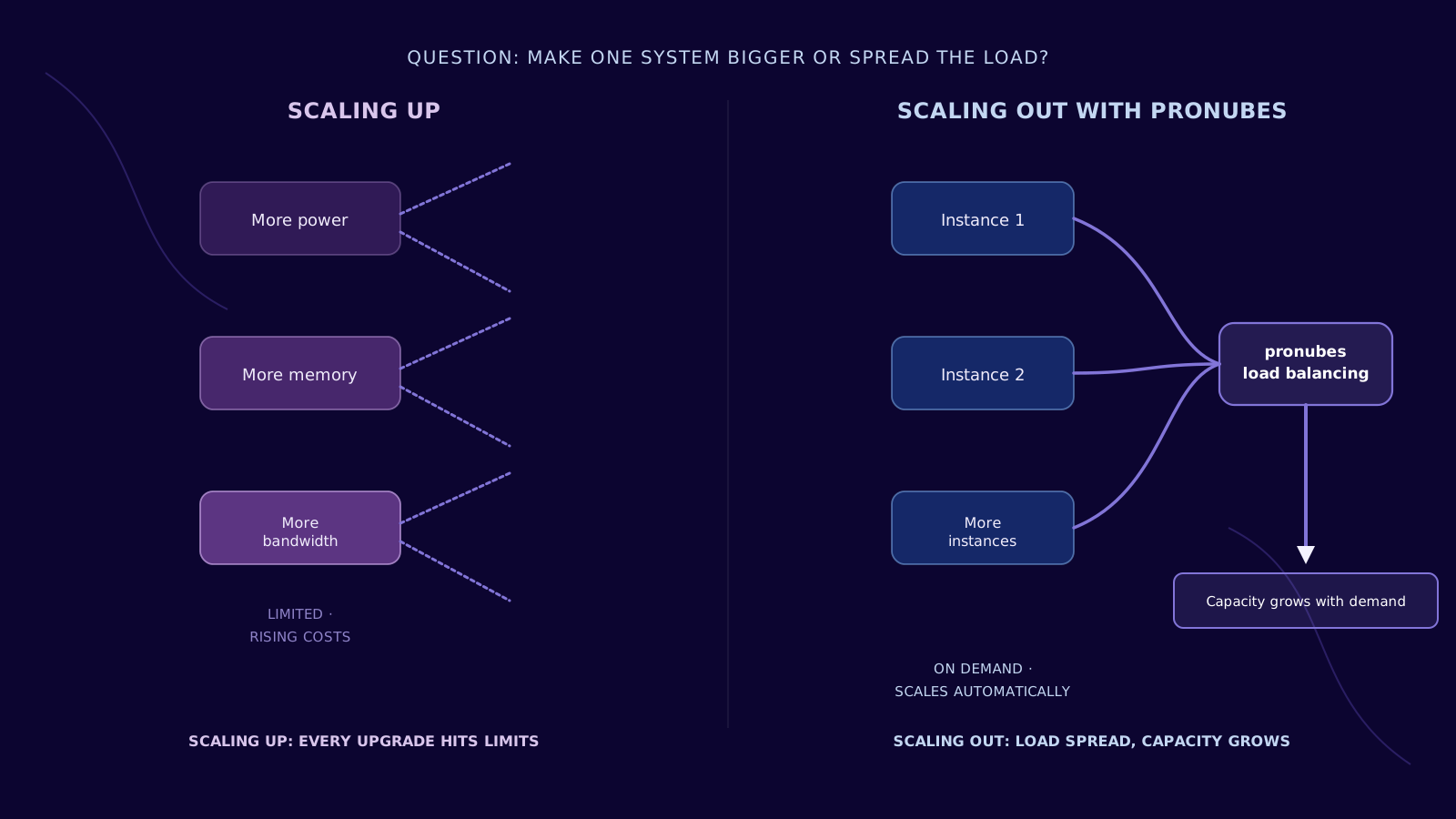
Scaling is the ability of a system to absorb growing demands on performance or capacity without cost and effort growing at the same rate. Two basic strategies exist: vertical scaling — a single system gets more compute, memory, or bandwidth — and horizontal scaling — several identical instances run in parallel and share the load. The US National Institute of Standards and Technology lists “rapid elasticity” as one of five essential characteristics in its 2011 definition of cloud computing (Special Publication 800-145) — the ability to automatically add or release capacity as demand changes.
Definition: Vertical and Horizontal Scaling
Scaling describes the ability of systems, applications, or platforms to increase their performance and capacity in line with rising demand, without losing efficiency. Two paths lead there, and they differ fundamentally in effort and limits.
Vertical scaling (scale up) equips a single system with more resources: more memory, more CPU cores, faster storage. Horizontal scaling (scale out) instead adds further, identical instances that share the load. Cloud platforms are built predominantly on horizontal scaling — the US National Institute of Standards and Technology lists “rapid elasticity” as one of five essential characteristics in its 2011 definition of cloud computing (Special Publication 800-145).
| Trait | Vertical scaling | Horizontal scaling |
|---|---|---|
| Principle | one system becomes more powerful | several instances share the load |
| Limit | bounded by the maximum hardware size | extendable to near-arbitrary scale |
| Failure behavior | a failure hits the entire system | one instance can fail while others take over |
| Precondition | usually possible without redesigning the application | requires a stateless, distributable architecture |
Why scaling becomes an architecture question
Modern industrial processes bring together a wide range of systems — from ERP software to SCADA systems, sensors, and cloud platforms. Without a scalable structure, every bit of growth — more machines, more sensors, more data volume — turns straight into a performance bottleneck instead of a capacity-planning question.
The difference shows up in a simple calculation: under linear horizontal scaling, throughput grows in proportion to the number of instances. Ten instances processing 1,000 messages per second each add up, on paper, to 10,000 messages per second. In practice that figure is rarely reached exactly — shared databases, coordination between instances, and network overhead all eat into the theoretical capacity. Computer scientist Gene Amdahl described exactly this effect back in 1967, in a paper presented at the AFIPS Spring Joint Computer Conference titled “Validity of the Single Processor Approach to Achieving Large Scale Computing Capabilities”: the portion of a task that cannot be parallelized limits how much benefit additional parallel capacity can deliver, no matter how many instances are added.
Knowing that limit turns scaling into an architecture decision made in advance, rather than a repair made after the first plant hits its capacity ceiling.
Building blocks of scalable systems
Four technologies form the practical foundation for scalable systems:
| Building block | Origin | Role in scaling |
|---|---|---|
| Cloud computing | NIST definition, 2011 | draw resources on demand instead of sizing hardware in advance |
| Microservices | term coined 2014 (Lewis/Fowler) | scale individual services independently instead of a whole application |
| Containerization (Docker, Kubernetes) | Docker 2013, Kubernetes 2014 | package applications portably and replicate them automatically |
| Edge computing | — | pre-process data near its source to cut bandwidth and central load |
James Lewis and Martin Fowler described the microservice approach in their article “Microservices,” published on 25 March 2014, as a way “to develop a single application as a suite of small services, each running in its own process” — and therefore independently scalable. Docker was first publicly demoed by Solomon Hykes at PyCon on 15 March 2013; Google released Kubernetes as an open-source project on 6 June 2014 for automating the deployment and scaling of containerized applications.
What underpins scaling
- Stateless services. A service that holds no session state of its own can be replicated freely — any instance can handle any request.
- Load balancing. A component in front distributes incoming requests across several identical systems, instead of routing all load to a single one.
- Queues and buffering. Message or event queues decouple producers from consumers, so load spikes get absorbed instead of passed straight through.
- Automated orchestration. Systems like Kubernetes start and stop instances automatically based on actual load, instead of permanently reserving capacity for peak demand.
Four steps to scalable systems
-
Identify the bottleneck
Which part of the system hits its limit first — compute, the database, the network, or a single step that cannot be parallelized?
-
Choose the scaling type
Vertical, if redesigning the application would be too costly; horizontal, if the architecture allows for stateless, distributable services.
-
Prepare the architecture
Move state out, separate the interfaces between services clearly — without this groundwork, horizontal scaling stays an intention rather than a reality.
-
Run and monitor automatically
Adjust capacity automatically to actual load, instead of permanently reserving it for the worst case.
What scaling is not
- Not purely a hardware question. More compute power does not help if the application itself cannot be distributed across several instances.
- Not the same as performance optimization. A faster system is not automatically a scalable one — scaling is about how capacity grows with load, not just speed in a single case.
- Not a one-time redesign. Demand keeps growing; a scalable architecture is an ongoing design decision, not a task you finish once.
- Not a blank check for unlimited growth. Under Amdahl’s law, the portion of a task that cannot be parallelized limits the benefit of adding more instances.
Common pitfalls in practice
- A shared database as bottleneck. Even if the application layer can be replicated, a single database that does not scale along with it remains the limiting factor.
- Monolithic architecture. An application built as one tightly coupled block can only be replicated as a whole — not specifically where the load actually occurs.
- Per-instance licensing costs. Some software is licensed per running instance — horizontal scaling can drive licensing costs harder than the underlying infrastructure.
- Coordination overhead between instances. More instances mean more coordination — for example, when several instances access the same record.
Horizontal scaling does not solve every problem: under Amdahl’s law, the portion of a task that cannot be parallelized remains a hard limit on the benefit of additional instances — ten times the servers rarely means ten times the throughput. And not every system needs to be built for maximum scalability: an internal report used by twenty people does not need an architecture built for twenty thousand.
How pronubes supports scaling
pronubes is built as a platform for a growing machine landscape — not for a fixed number of assets.
- pronubes Edge connects new machines following the same pattern — without every additional asset needing its own one-off solution.
- pronubes Zones keeps the structure consistent even as the number of connected systems grows.
- pronubes Insights stays analyzable whether ten or a thousand machines are feeding it data — analysis scales with data volume, not with manual extra effort.
That keeps growth a question of capacity, not of architecture. More on the platform
- Vertical scaling (scale up)
- A single system is given more resources — more compute, memory, or bandwidth.
- Horizontal scaling (scale out)
- Several identical instances run in parallel and share the load.
- Rapid elasticity
- One of five characteristics in NIST’s definition of cloud computing: automatically adding or releasing capacity as demand changes.
- Microservices
- Architectural style in which an application consists of several independently running, individually scalable services.
- Containerization
- Packaging an application with all its dependencies into a portable, reproducible unit, for example with Docker.
- Amdahl’s law
- Principle formulated by Gene Amdahl in 1967: the portion of a task that cannot be parallelized limits the benefit of additional parallel capacity.
Frequently asked questions
Is horizontal scaling always better than vertical?
Not by default. Vertical scaling is often simpler to implement as long as the hardware ceiling has not been reached. Horizontal scaling requires a stateless architecture, but in return offers virtually no fixed capacity limit.
Does more compute power automatically scale any application?
No. Under Amdahl’s law, the portion of a task that cannot be parallelized limits the benefit of additional capacity — an application with many sequential dependencies gains little from extra instances.
Do I need microservices to scale?
Not necessarily, but they help a great deal: individual services can be replicated exactly where load actually occurs, instead of duplicating the entire application as one unit.
What does a lack of scalability cost?
Mostly time under pressure: a system that hits its limit is rarely easy to redesign on short notice — often the only quick fix left is more expensive hardware.
Does every system need to be built for maximum scalability?
No. An internal application used by twenty people doesn’t need an architecture built for twenty thousand — the effort should match the expected growth.
 What Is Connectivity in Industry? Why protocol diversity becomes the core question Keep reading
 What Is Separation of Concerns? One boundary per responsibility, not one system for everything Keep reading
 Agility and Flexibility for IT Strategies How pronubes makes IT strategies more adaptable Keep reading
An architecture that grows with your machine landscape, instead of limiting it.
30 minutes on your growth curve: where your system hits its limits today, what separates vertical from horizontal scaling, and where scaling fails in practice.
pronubes is a product of inray Industriesoftware GmbH. Over 30 years of industrial software made in Germany. Innovative and reliable for manufacturing companies.