
Connectivity is the ability to link machines, sensors, controllers, software systems, and platforms so that data flows continuously and reliably — horizontally between systems at the same level, and vertically from the field level up into ERP and cloud systems. The practical difficulty rarely lies in a single connection, but in the sheer number of different protocols in use: a controller from the 1980s often speaks Modbus, a modern automation system speaks OPC UA, and a cloud application speaks MQTT or HTTP. Without a translator in between, every connection stays a one-off that starts from scratch with the next machine. In classic IT environments, connectivity mostly means linking computers and systems over a network. In industry, the term is broader: it describes the ability to connect machines, sensors, controllers, software systems, and platforms so that continuous data flows emerge. Those data flows run in two directions: horizontally between systems at the same level, say between two lines in the same plant, and vertically across the levels of the automation hierarchy. A widely used model for that hierarchy comes from the International Society of Automation (ISA) with the ANSI/ISA-95.00.01 standard, whose first part was published in 2000: from the field level with sensors and actuators, through the control and supervisory level, up to manufacturing execution systems (MES) and enterprise IT (ERP). Production plants grow over decades. A controller from the 1980s or 1990s stands right next to a line that started up two years ago — and both are expected to deliver the same kind of data. The real problem is rarely the absence of a connection, but the sheer number of different protocols that coexist. Modbus, for instance, was developed in 1979 by the manufacturer Modicon for its own programmable logic controllers and is still in use in many plants today. OPC UA, specified in the IEC 62541 series and first published in 2011 by the international standards body IEC, targets vendor-independent, platform-independent communication between modern automation systems instead. MQTT, in turn, originated in 1999 at IBM (Andy Stanford-Clark) and Arcom (Arlen Nipper) for satellite-based monitoring of oil pipelines, and became an official OASIS standard on 29 October 2014 — today one of the most widely used protocols for connecting individual sensors to cloud platforms. Anyone wiring up each of these connections by hand quickly runs into a number that grows faster than the number of systems itself: with n systems each connected directly to one another, up to n(n-1)/2 possible point-to-point links can result. With ten systems, that is already forty-five possible connections; with twenty, one hundred and ninety. Each new machine does not add cost in a straight line — it adds cost against every machine already connected. A slice of the protocols that coexist in production environments: Which systems exist, which protocol does each one speak, and how well is that documented? A gateway or middleware that covers the protocols already in use, instead of building a one-off solution for every machine. A consistent structure before data starts flowing at scale — it is hard to standardize after the fact. Start with the most important or most accessible systems, check data quality, then expand. More connectivity also means a larger attack surface: every new connection is another crossing that has to be monitored. An approach such as the NAMUR Open Architecture (NOA) addresses this by routing monitoring and optimization data through a second, parallel channel instead of changing the existing, safety-critical automation system itself. Not every system needs the same depth of connection, either: a simple meter reading needs less protection than a safety-relevant process controller. pronubes is the platform between the shop floor and IT — and that is exactly where connectivity starts. That turns individual connections into a structure that grows with every new machine, instead of starting over from scratch each time. More on the platform No, but the two belong together. Connectivity creates the technical precondition — working connections across protocols and systems. Convergence builds on that, describing controlled data exchange across the boundary between IT and OT. Often, yes, in newly built plants. But as soon as older controllers speaking Modbus or another legacy protocol are in the mix, a single protocol rarely covers the entire system landscape. Directly, often not very, since many OT systems were never designed for network access. A protocol gateway or middleware between OT and IT, combined with network segmentation, reduces that risk substantially. Mostly time and information silos: data that would technically exist cannot be brought together, because every connection is a one-off that has to be rebuilt for the next machine. No. The right level of depth depends on the purpose — a simple meter reading needs a different connection than a safety-relevant process controller.What Is Connectivity in Industry?
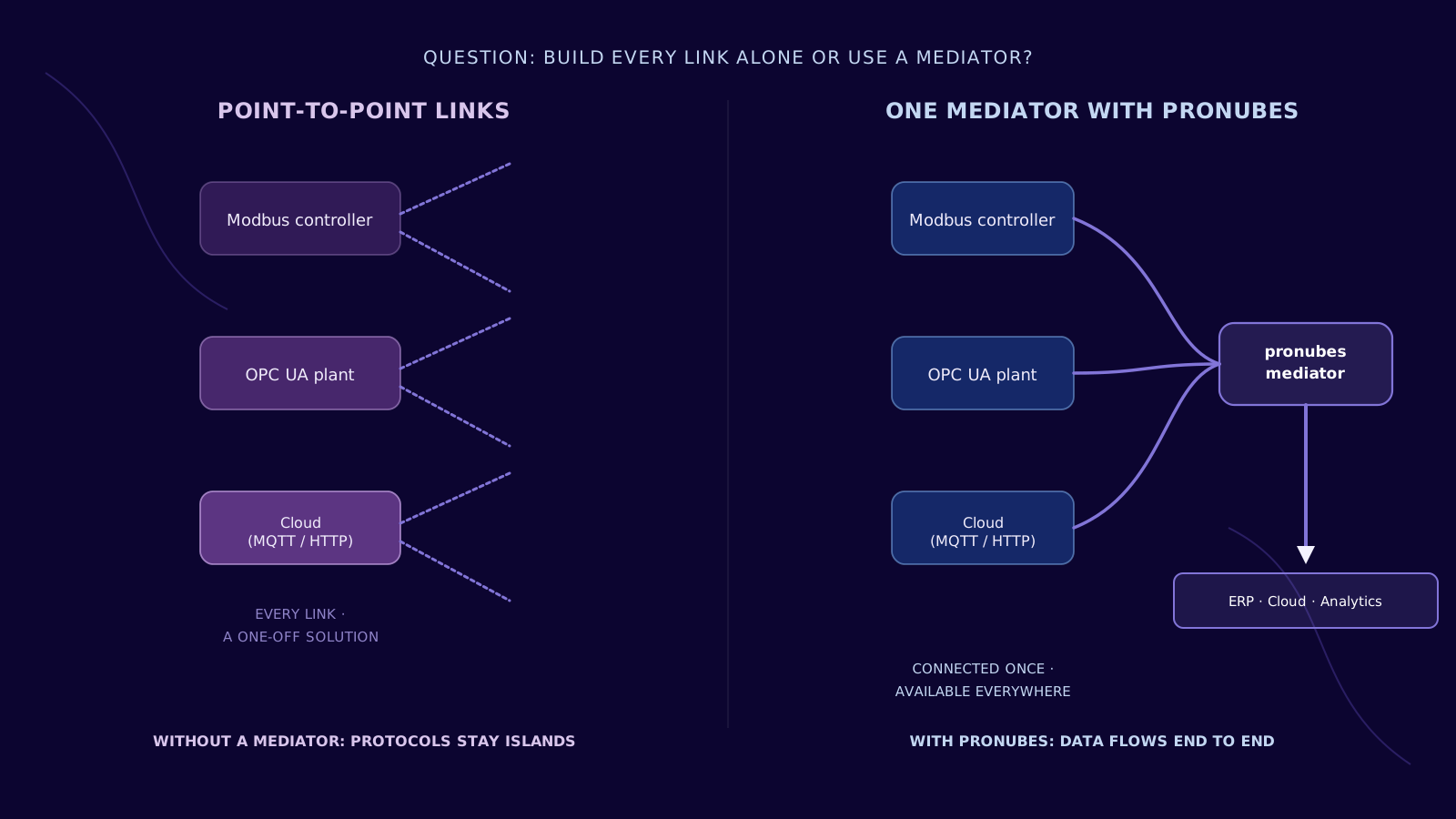
Definition: Connectivity in Industry
Level
Example systems
Typical protocols
Field level
sensors, actuators
Modbus, PROFINET
Control and supervisory level
PLCs, SCADA, DCS
OPC UA, Modbus, PROFINET
MES level
manufacturing execution system
OPC UA, MQTT, REST
ERP and cloud level
enterprise software, cloud platforms
HTTP, REST, MQTT
Why connectivity becomes a precondition
A slice of the protocol landscape
Protocol
Origin
Typical use
Modbus
1979, Modicon
older PLCs, serial and Ethernet fieldbuses
OPC UA (IEC 62541)
2011 (IEC), updated 2015
vendor-independent automation, semantic interoperability
MQTT
1999 (IBM/Arcom), OASIS standard since 2014
sensors, IoT devices, cloud connectivity
HTTP/REST
standard IT protocols
web interfaces, APIs, ERP and cloud systems
What underpins end-to-end connectivity
Four steps to end-to-end connectivity
Take stock
Choose a mediation layer
Define naming
Connect and monitor incrementally
What connectivity is not
Common pitfalls in practice
How pronubes builds connectivity
Frequently asked questions
Is connectivity the same thing as IT/OT convergence?
Isn’t a single protocol like OPC UA enough?
How safe is it to connect old controllers?
What does a lack of connectivity cost?
Does every machine need to be connected to the same depth?
 What Is the Difference Between IT and OT? Why the security priorities reverse Keep reading
 What Is Separation of Concerns? One boundary per responsibility, not one system for everything Keep reading
 Cybersecurity and Risk Management How pronubes secures data flows Keep reading
A translator between your protocols, not a one-off fix per machine.
30 minutes on your protocol and system landscape: which connections exist today, where middleware fits in, and where connectivity fails in practice.
pronubes is a product of inray Industriesoftware GmbH. Over 30 years of industrial software made in Germany. Innovative and reliable for manufacturing companies.