
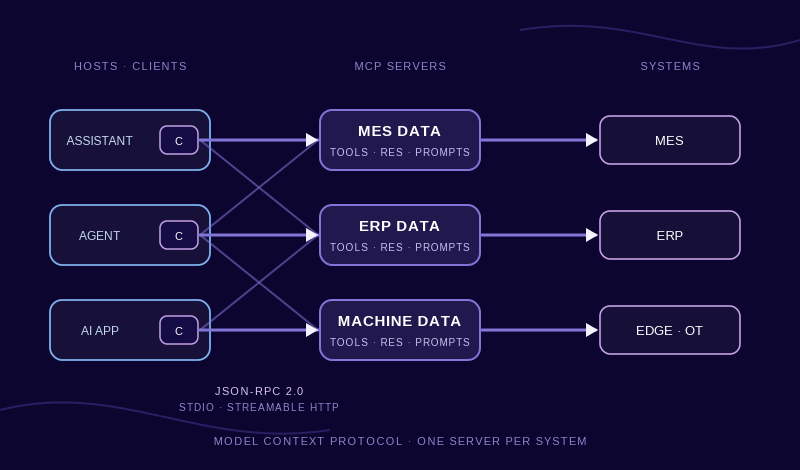
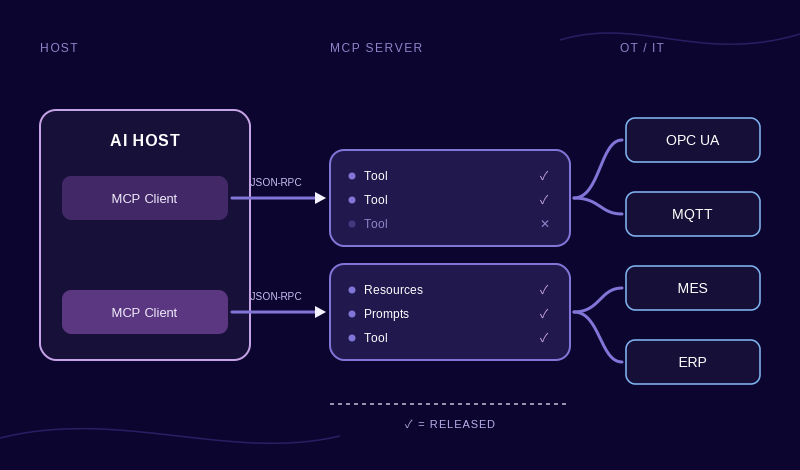
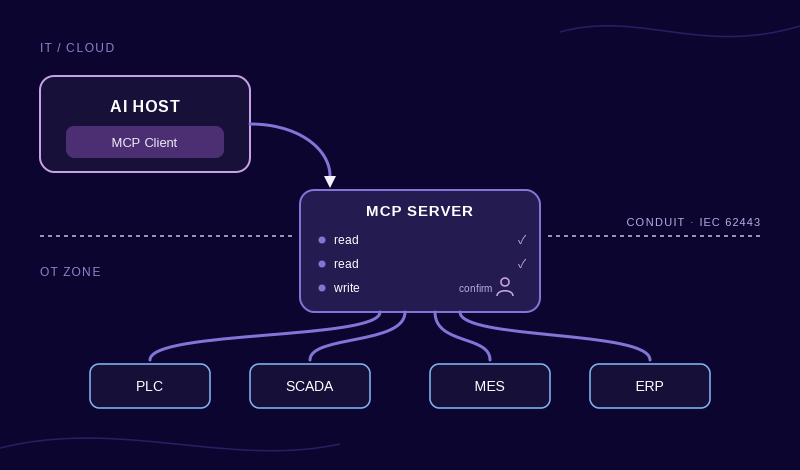
An MCP server is a service that provides data and functions to an AI application via the Model Context Protocol (MCP). It describes which tools, resources and templates it offers, and the AI application calls them through a uniform message format. In manufacturing, an MCP server can, for example, make machine states, order data or fault messages readable without every AI application needing its own interface to every system. The Model Context Protocol distinguishes three roles. The specification describes hosts as AI applications that initiate connections, clients as connectors within the host application and servers as services that provide context and capabilities. The MCP server is therefore the side that accesses data and systems. The basics and use of the protocol are explained on the pages Model Context Protocol and MCP in manufacturing. This page focuses on the server: what it offers, how it is connected and what matters in the plant. Anthropic introduced the Model Context Protocol as an open standard in November 2024. On 9 December 2025, MCP was handed over to the Agentic AI Foundation, a directed fund under the Linux Foundation co-founded by Anthropic, Block and OpenAI. The current version of the specification is dated 28 July 2026. The reason for MCP servers is an arithmetic problem. An example with assumed values: four AI applications need access to six systems, such as MES, ERP, historian, quality database, maintenance system and document storage. With individual interfaces, that is 4 · 6 = 24 integrations. With MCP, each system gets a server and each application a client, which makes 4 + 6 = 10 building blocks. If a seventh system is added, it needs one more server instead of four more interfaces. The specification names three kinds of offerings a server can provide. On top of that come the message format and the transports. Four points determine whether an MCP server works reliably and securely in the plant. The sequence is similar for most projects. Which questions should employees ask an assistant, and which data does it need for this? This determines which systems a server has to connect. Each tool gets a clear task and an understandable description. Read-only tools first, writing tools only after approval. Locally via stdio or centrally via Streamable HTTP, with authorization, logging and access only to the network segments needed. Answers are checked with real questions from the plant. Further systems follow, each as its own server or as new tools. Four distinctions help with classification. These points cost the most time in MCP projects. An MCP server makes data reachable for AI; it does not make it correct. If the connection to machines and MES delivers incomplete or outdated values, the assistant gives convincingly worded but wrong answers. And every writing tool is a new path into production that must be secured just like any other access. An MCP server is only as good as the data it accesses. pronubes creates this foundation in the plant. The product components have different responsibilities. It provides data and functions to an AI application via the Model Context Protocol. The application asks which tools, resources and templates the server offers and calls them through uniform JSON-RPC messages. The client sits in the AI application and establishes the connection. The server sits with the data and systems and delivers what the client requests. An application can be connected to several servers, with one client per server. Technically yes, but it is usually not advisable. It is safer and more understandable if the server accesses an existing, structured data layer that already connects machines via OPC UA or MQTT, and if writing access is tightly limited. Local servers run on the same computer as the AI application and communicate via stdio. Central servers run in the network and are addressed via Streamable HTTP with authorization. In plants with several users, central operation usually makes sense. Anthropic introduced MCP in November 2024 and handed it over on 9 December 2025 to the Agentic AI Foundation, a directed fund under the Linux Foundation. The specification is developed openly. pronubes connects machines and systems and delivers the structured production data an MCP server accesses.What is an MCP server and how does it connect production data?
Definition: MCP server
Role
Task according to the specification
Example from manufacturing
Host
AI application that initiates connections
An assistant for shift supervisors or maintenance
Client
Connector within the host, one client per server
The component that talks to the server for machine data
Server
Service that provides context and capabilities
A service that delivers machine states, orders or fault messages
Why MCP servers emerge
What an MCP server offers
Building block
Meaning according to the specification
Example from manufacturing
Tools
Functions for the AI model to execute
Query downtime of a line for a period
Resources
Context and data for the user or the AI model to use
Plant structure, maintenance manual, current order
Prompts
Templated messages and workflows
Template for a shift handover or fault analysis
JSON-RPC 2.0
Message format between client and server
Every request and response follows the same structure
stdio
Transport over the standard streams of a locally launched process
A server runs on the same computer as the assistant
Streamable HTTP
Transport via HTTP POST to an MCP endpoint
A central server in the plant network for several applications
How an MCP server works technically
Four steps to your own MCP server
Clarify questions and users
Define tools and resources
Decide on transport and permissions
Test and roll out
What an MCP server is not
Typical hurdles in practice
How pronubes supports
Frequently asked questions
What does an MCP server do?
What is the difference between an MCP client and an MCP server?
Can an MCP server access machines directly?
Local or central: how is an MCP server operated?
Who owns the Model Context Protocol?
Good answers need good data.
pronubes is a product of inray Industriesoftware GmbH. Over 30 years of industrial software from Germany. Innovative and reliable for manufacturing companies.