
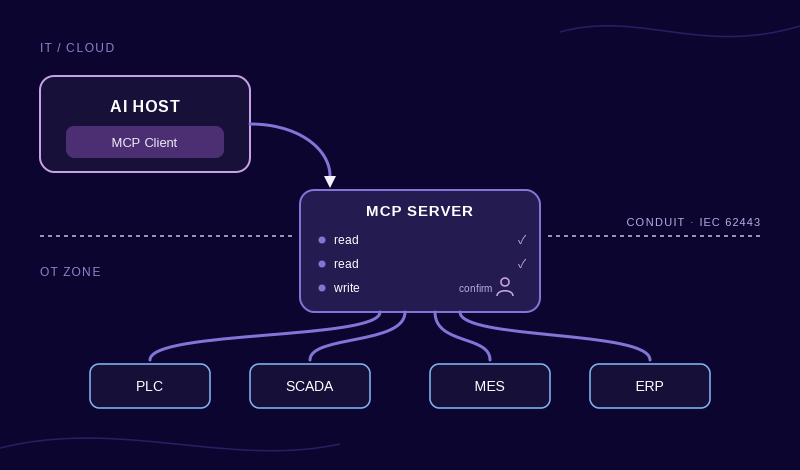
The Model Context Protocol (MCP) is an open standard that lets AI applications access data and functions of other systems. An MCP server provides resources, prompt templates and tools, and the AI application uses them through an MCP client. In industry, this makes it possible to connect an AI assistant to production data without building a separate interface for every combination. What the AI is allowed to do is set by releases and permissions, not by the protocol. The Model Context Protocol describes how an AI application talks to external data sources and tools. The specification names three roles. A host is the AI application that initiates connections. Clients are connectors within that application. Servers provide context and capabilities. Messages between them follow the JSON-RPC 2.0 format. Anthropic introduced MCP as an open standard on 25 November 2024. The goal: to replace individual, newly built integrations between AI applications and data sources with one shared protocol. On 9 December 2025, Anthropic handed MCP over to the Agentic AI Foundation, a directed fund under the Linux Foundation, co-founded with Block and OpenAI. At that time, Anthropic cited more than 10,000 active public MCP servers. A rough calculation shows why this matters for integrations. Purely as an illustration: three AI applications that each connect eight systems directly need 3 × 8 = 24 individual integrations. If they all use MCP, each system needs one server and each application one client, 3 + 8 = 11 building blocks in total. Each additional system is then added with one server instead of three new integrations. The numbers are a worked example, not a measurement from a project. The current version of the specification is dated 28 July 2026. Some of its building blocks rely on older standards. Four points determine how a connection works. The sequence is similar in most projects. What such a setup looks like in manufacturing is shown on the page MCP in production. Which question should the AI answer, for example about the state of a line or the causes of last week’s downtime? Decide which data appears as resources and which queries appear as tools. Start with read-only tools. Clarify the network path, authentication and roles before the first client connects. Check the answers with the future users and only extend releases once they work reliably. Four distinctions prevent false expectations. These points slow down MCP projects in production most often. MCP makes connections easier, not automatically secure. Whether a tool only reads or writes to a plant is decided by the server’s implementation and your release, not by the protocol. In production, it is therefore advisable to start with read-only tools and to allow writing tools only with clear responsibility and confirmation by a person. pronubes provides production data for AI applications in a targeted way. The product parts have different tasks. Anthropic introduced MCP on 25 November 2024. Since 9 December 2025, the protocol has been with the Agentic AI Foundation, a directed fund under the Linux Foundation. No. MCP is an open standard. Any AI application that includes an MCP client can connect to MCP servers. Technically, a tool can also write. Whether it is allowed to is decided by the server’s implementation and your releases. In production, it is advisable to start with read-only tools. No. OPC UA connects machines and systems. MCP connects AI applications with data and tools and therefore sits one level higher. For HTTP transports, the specification describes optional authorization based on OAuth 2.1, and local servers obtain credentials from their environment. In addition, network paths, roles and releases on your side apply. pronubes Edge can serve as an MCP server. Only what you release individually appears as a tool.What is the Model Context Protocol (MCP) and what does it mean for industry?
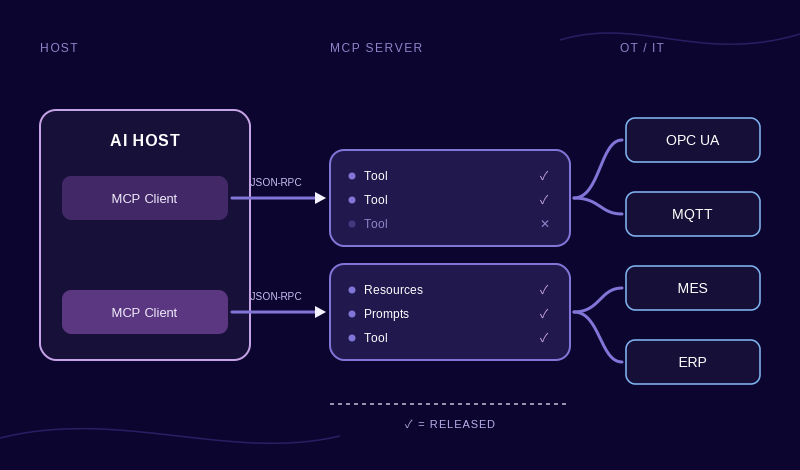
Definition: Model Context Protocol
Role
Task according to the specification
Example from industry
Host
AI application that initiates connections
An AI assistant for maintenance or shift supervision
Client
Connector within the host
The component in the assistant that talks to a specific server
Server
Provides context and capabilities
A service that delivers machine states, order data or key figures
Why a shared standard makes sense
What MCP consists of
Building block
Task
Origin
JSON-RPC 2.0
Message format for requests, responses and notifications
Specification dated 26 March 2010, jsonrpc.org
Resources
Context and data for the user or the AI model
MCP specification, server feature
Prompts
Templates for messages and workflows
MCP specification, server feature
Tools
Functions the AI model can execute
MCP specification, server feature
Transports
stdio for local processes, Streamable HTTP for access over the network
MCP specification
Authorization
Optional, for HTTP transports based on OAuth 2.1
MCP specification, based on the IETF draft of OAuth 2.1
How MCP works technically
Four steps to a first connection
Define the question
Select data and functions
Provide and secure the server
Test and expand step by step
What MCP is not
Typical hurdles in practice
How pronubes helps
Frequently asked questions
Who is behind MCP?
Is MCP tied to a specific AI model?
Can an AI control machines via MCP?
Does MCP replace OPC UA?
How is access secured?
Providing production data for AI is above all about releasing it selectively.
pronubes is a product of inray Industriesoftware GmbH. Over 30 years of industrial software from Germany. Innovative and reliable for manufacturing companies.