
What does IT reliability really bring CIOs?
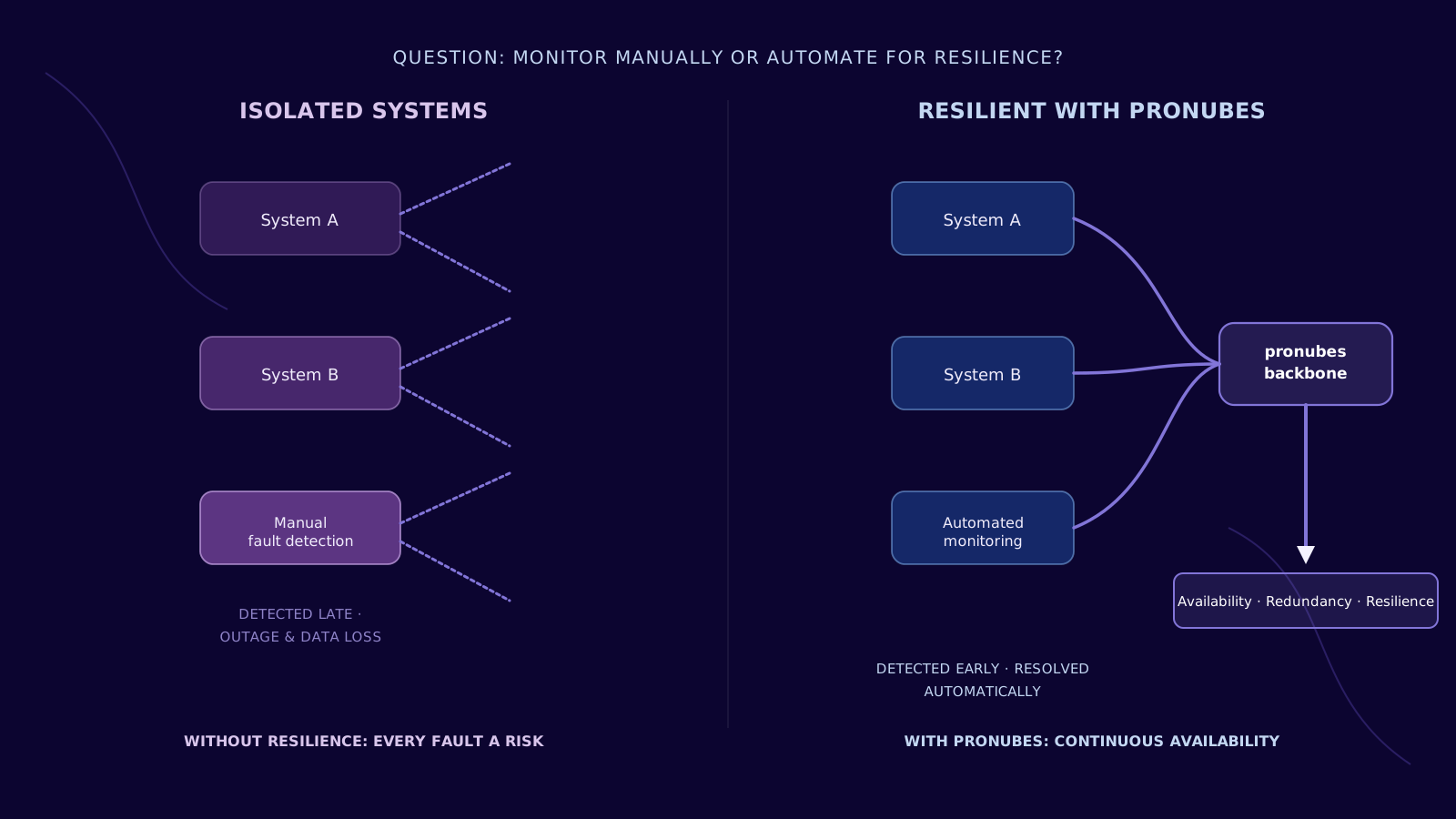
IT reliability describes the ability of IT systems to keep running reliably despite disruptions, or to recover from them quickly — through redundancy, automated monitoring, and an end-to-end data base. pronubes connects IT and OT, laying the foundation for continuous availability instead of costly outages.
What is IT reliability?
IT reliability describes the ability of IT systems to keep running reliably despite disruptions or outages, or to be restored quickly. It goes beyond classic IT security: while security protects against attacks, reliability ensures the continuous availability of applications, data, and processes.
For CIOs, this is strategically important. Every unplanned outage can cause financial damage, interrupt production processes, or permanently damage the trust of customers and partners. IT reliability therefore means more than technology — it means business-critical resilience.
Why it is critical
An IT outage is far more than a technical problem. Studies show that just a few hours of downtime can cause substantial financial damage. In industry, interrupted production lines, disrupted supply chains, or the standstill of connected machines can endanger not just efficiency, but entire business models.
Especially in sectors such as automotive, machine building, chemicals, or energy supply, IT outages have immediate and sometimes severe consequences. Added to this are indirect costs: frustrated business partners, delivery delays, contractual penalties, or the risk of no longer meeting regulatory requirements.
How IT reliability is achieved
To ensure IT reliability, companies rely on a range of technical and organizational measures: redundancy and high availability, where systems are designed so that the failure of individual components doesn't stop operations; monitoring and automation, where modern tools detect anomalies early and react automatically before a standstill occurs; and cloud and multi-cloud approaches, which minimize risk and increase flexibility by distributing workloads across different platforms.
This is where the IT/OT platform pronubes comes in: it provides a transparent, clear data structure and lays the foundation for high availability, automation, and monitoring — with the ability to quickly integrate new devices, systems, or cloud applications.
Examples from practice
A production company mirrors business-critical control systems onto a redundant system, so a hardware failure doesn't interrupt operations. An energy provider monitors its control systems automatically and detects anomalies before they lead to a widespread outage — instead of reacting only after customer complaints.
A logistics company distributes critical applications across multiple cloud regions, so the failure of one data center doesn't disrupt supply chains. In every case, the added value only emerges when redundancy, monitoring, and an end-to-end data base work together — not through isolated individual measures.
The role of the CIO
The CIO is responsible for anchoring IT reliability as a fixed part of IT and business strategy. They must ensure that technical measures are embedded in a clear business context rather than viewed in isolation.
Their core tasks include: assessing risks and prioritizing investments — which systems are business-critical, where does redundancy add the most value; bridging business and IT, since departments expect availability and stability; and communicating the importance of reliability at board level, so the necessary budgets are secured long term.
What IT reliability is not
IT reliability is not the same as classic IT security — security protects against attacks, while reliability ensures continuous availability, including against hardware failures, human error, or capacity bottlenecks that have nothing to do with an attack.
Nor is it a one-time project that ends once redundancy is introduced, and it is not simply a backup strategy: a backup protects data but doesn't prevent downtime. Only the interplay of redundancy, monitoring, and an end-to-end data base makes a system genuinely reliable.
Common obstacles in practice
The biggest obstacle is often not the individual component, but integration: different systems, protocols, and platforms make it difficult to implement redundancy and monitoring end to end. Without a shared data base, each protective measure remains valuable on its own but disconnected in the bigger picture.
Added to this is often an organizational obstacle: reliability is planned in isolation from IT strategy and not communicated as a business-critical success factor. Successful companies anchor reliability strategically from the start, rather than treating it as a pure cost factor.
How pronubes helps
In a digitalized world, every minute of IT downtime can mean substantial losses — production stoppages, frustrated customers, or contractual penalties. The good news: reliability can be planned and consistently implemented. pronubes is the platform for making IT infrastructures resilient and future-proof.
pronubes combines technological excellence with practical strategies tailored exactly to the needs of CIOs — for a reliability that acts not as a pure cost factor, but as an enabler for innovation, digitalization, and sustainable growth.
IT reliability doesn't come by chance, but from a platform that connects IT and OT.
pronubes builds the end-to-end data base for redundancy, monitoring, and continuous availability — instead of costly outages and isolated point solutions.
pronubes is a product of inray Industriesoftware GmbH. Over 30 years of industrial software from Germany. Innovative and reliable for manufacturing companies.