
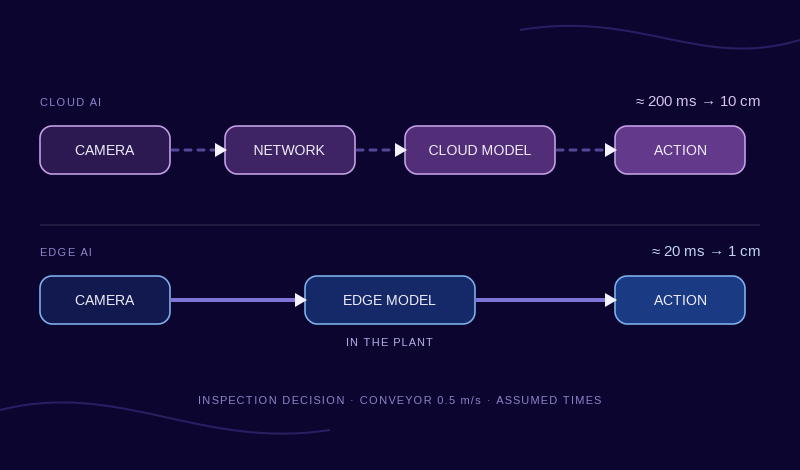
Edge AI means running AI models close to the data source, for example on an industrial PC in the plant or directly on a device, instead of in a remote data centre or in the cloud. A model is usually trained centrally and applied on site. In manufacturing, edge AI pays off above all when answers are needed within milliseconds, large amounts of data arise or the equipment has to keep running without an external connection. Edge AI combines two terms. The international report ISO/IEC TR 23188 (February 2020) describes edge computing as distributed computing in which processing and storage take place at or near the edge of the network, with nearness defined by the requirements of the system. Edge AI means running a trained AI model in this way. Technically, this step is called inference: the model applies what it has learned, for example an inspection decision or a forecast. The idea of moving analysis closer to the devices is not new. In its Fog Computing Conceptual Model (NIST SP 500-325, 14 March 2018), the US National Institute of Standards and Technology described how applications, management and data analytics move from the data centre into the network itself. Since lightweight runtimes for AI models became available, this also applies to machine learning. A simple example shows how much response time matters. A conveyor runs at 0.5 metres per second, and a camera inspects every part. If the inspection decision takes 200 milliseconds via the cloud, the part has moved 10 centimetres by the time the answer arrives. If a model in the plant decides in 20 milliseconds, it is 1 centimetre. The times are assumed, not measured. The example shows why, for fast processes, the distance between model and equipment also shapes the design of the line. Edge AI is made up of hardware, runtime, model format and connectivity. Four mechanisms carry the approach. The sequence is similar in most projects. Does the case really need short response times, large data volumes on site or operation without a network? If not, central AI is simpler. The required signals are connected and stored with context. The model is trained centrally with this data. The model first runs on one machine, in parallel with the existing process. Results and input data are measured. Further equipment follows with consistent naming of the data. A fixed process governs updates and new model versions. Four distinctions prevent false expectations. These points slow down edge AI projects most often. Edge AI solves a problem of distance, not of data quality. Where response time and data volume do not matter, for example in a daily forecast for planning, a centrally run model is easier to maintain. Every model at the edge means one more place where versions, updates and monitoring have to be organised. pronubes does not supply an AI model. The platform provides the infrastructure that reliably supplies a model at the equipment with data and brings its results back into the process in a controlled way. The product components have different tasks. With cloud AI, the model runs centrally and the data is sent there. With edge AI, the model runs close to the equipment and only results or selected data leave the plant. Many solutions combine both: train centrally, apply locally. Usually not. Training needs a lot of data and computing power and therefore takes place mostly centrally. The finished model runs at the edge. Retraining uses data that flows back from operation. That depends on the model. For image processing, industrial PCs with accelerators are often used; for simple signal analysis, gateways or even microcontrollers are enough. Response time, model size and operating conditions in the plant are decisive. Technically this is possible, organisationally it is a deliberate decision. Many companies start with recommendations to operators and let a model intervene only after a trial period and within clear limits. With a use case in which response time, data volume or independence from the network really matter, and with connecting the data it needs. The model first runs on one machine in parallel with the existing process. pronubes connects machines and systems and brings AI insights back into the process in a controlled way.What is edge AI and when is it worth it in manufacturing?
Definition: edge AI
Characteristic
AI in the cloud or data centre
Edge AI
Place of inference
Central, outside the plant
In the plant, close to the equipment or sensor
Response time
Depends on network path and load
Short and predictable
Data transfer
Raw data has to leave the plant
Only results and selected data leave the plant
Network failure
Model cannot be reached
Model keeps working locally
Operation
One place for updates and monitoring
Many places that have to be managed
Why AI is moving to the equipment
The building blocks of edge AI
Building block
Task
Origin
Edge hardware
Runs the model, from industrial PCs through gateways to microcontrollers
Term edge computing according to ISO/IEC TR 23188, 2020
Runtime
Runs models on devices with little memory and short response times
For example TensorFlow Lite, released by Google as a developer preview on 14 November 2017
Exchange format
Makes models portable between different AI tools
ONNX, introduced by Facebook and Microsoft on 7 September 2017
AI on tiny devices
Models on microcontrollers with very low power consumption
TinyML, book by Pete Warden and Daniel Situnayake, O’Reilly, December 2019
Data connectivity
Supplies the model with input data from controllers and systems
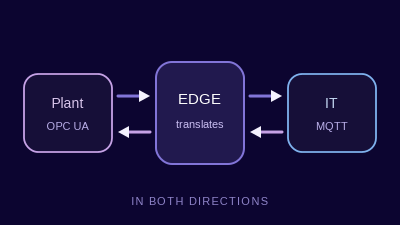
Open standards such as OPC UA (IEC 62541) and MQTT (OASIS, 2014)
How edge AI works technically
Four steps to edge AI
Check the use case
Connect data and train the model
Run it on one machine
Transfer and maintain
What edge AI is not
Typical hurdles in practice
How pronubes supports
Frequently asked questions
What is the difference between edge AI and cloud AI?
Is training also done at the edge?
What hardware does edge AI need?
Should an edge AI model intervene in the process itself?
How do you start with edge AI?
AI models belong where the data is created.
pronubes is a product of inray Industriesoftware GmbH. Over 30 years of industrial software from Germany. Innovative and reliable for manufacturing companies.